7/8 US Stock Market - Iran Ceasefire Collapse Fears Shake Markets, Energy Soars
July 08, 2026 Market Analysis
## 1. What Happened Today?
The US stock market trembled under geopolitical risk, while oil and energy stocks soared.
- S&P 500: Fell more than -1% during the day before reducing losses to close down about -0.3% (apnews.com)
- Dow: Showed relative weakness with a decline of -1.1% due to its large number of economically sensitive stocks (apnews.com)
- Nasdaq: Rebounded from early weakness to close up +0.2%, with growth and technology stocks defending against further declines (apnews.com)
The key factors that shook the market today were Middle East geopolitical risks and rising oil prices.
- President Trump's statement "the ceasefire with Iran is over" raised concerns about a full-scale confrontation between the US and Iran. (apnews.com)
- Brent crude oil prices surged more than 5%, reaching around $78 per barrel, and briefly exceeding $80 during the day. (apnews.com)
- Global markets shifted into a general risk-off mode, with not only the US but also European and Asian markets experiencing declines. (apnews.com)
In summary:
> War risk resurgence → Oil price surge → Inflation and interest rate concerns → Overall stock market decline, energy sector benefits
Investors are currently most concerned about the possibility that rising oil prices could lead to higher inflation, interest rates, and a slowdown in economic growth.
---
## 2. Sector Report Card - Energy Smiles While Others Struggle
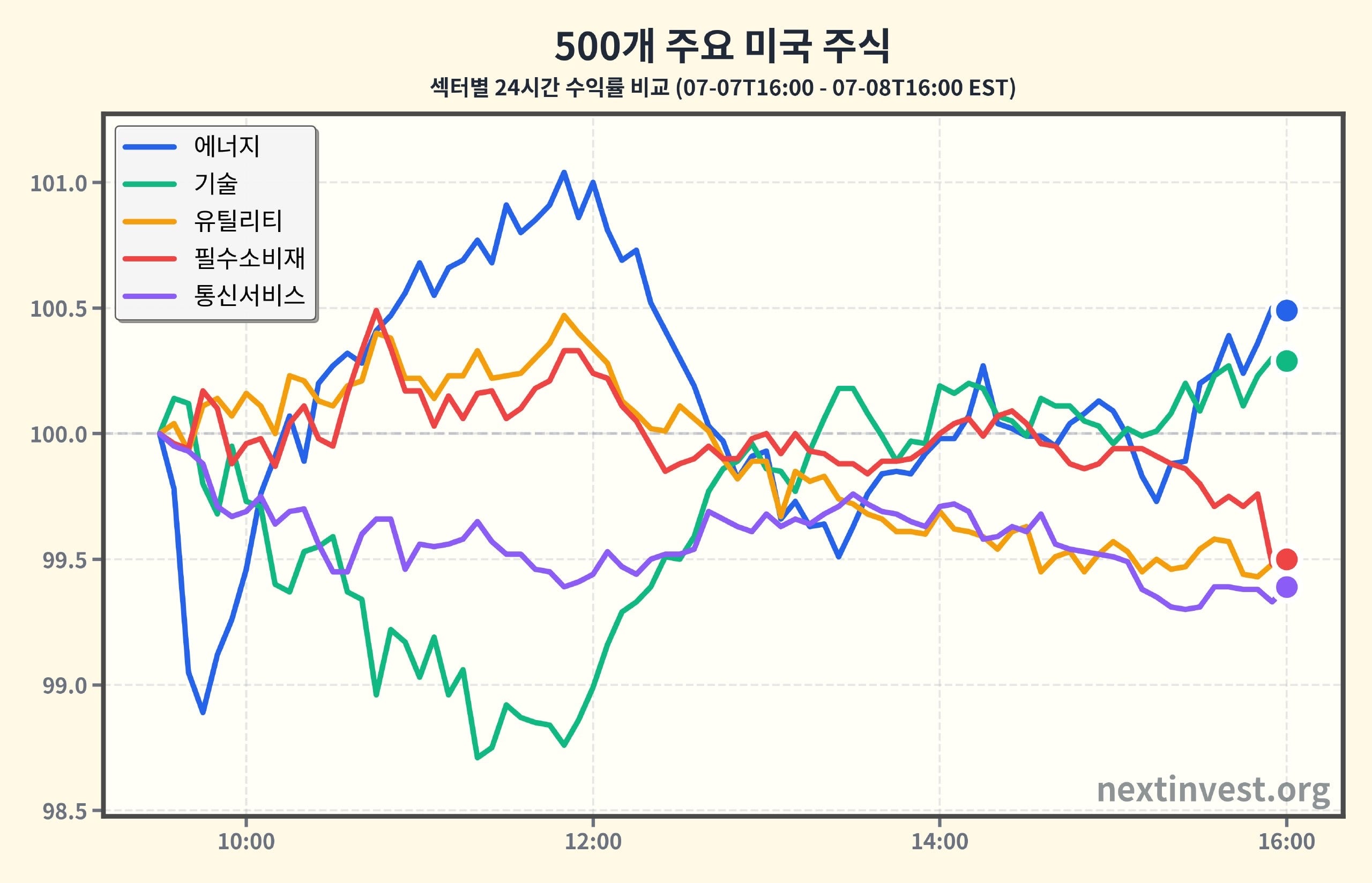
Based on the sector returns you provided (24-hour basis), out of the 11 GICS sectors, energy is the only one showing positive performance.
### 2-1. Energy: Direct Beneficiary of Rising Oil Prices
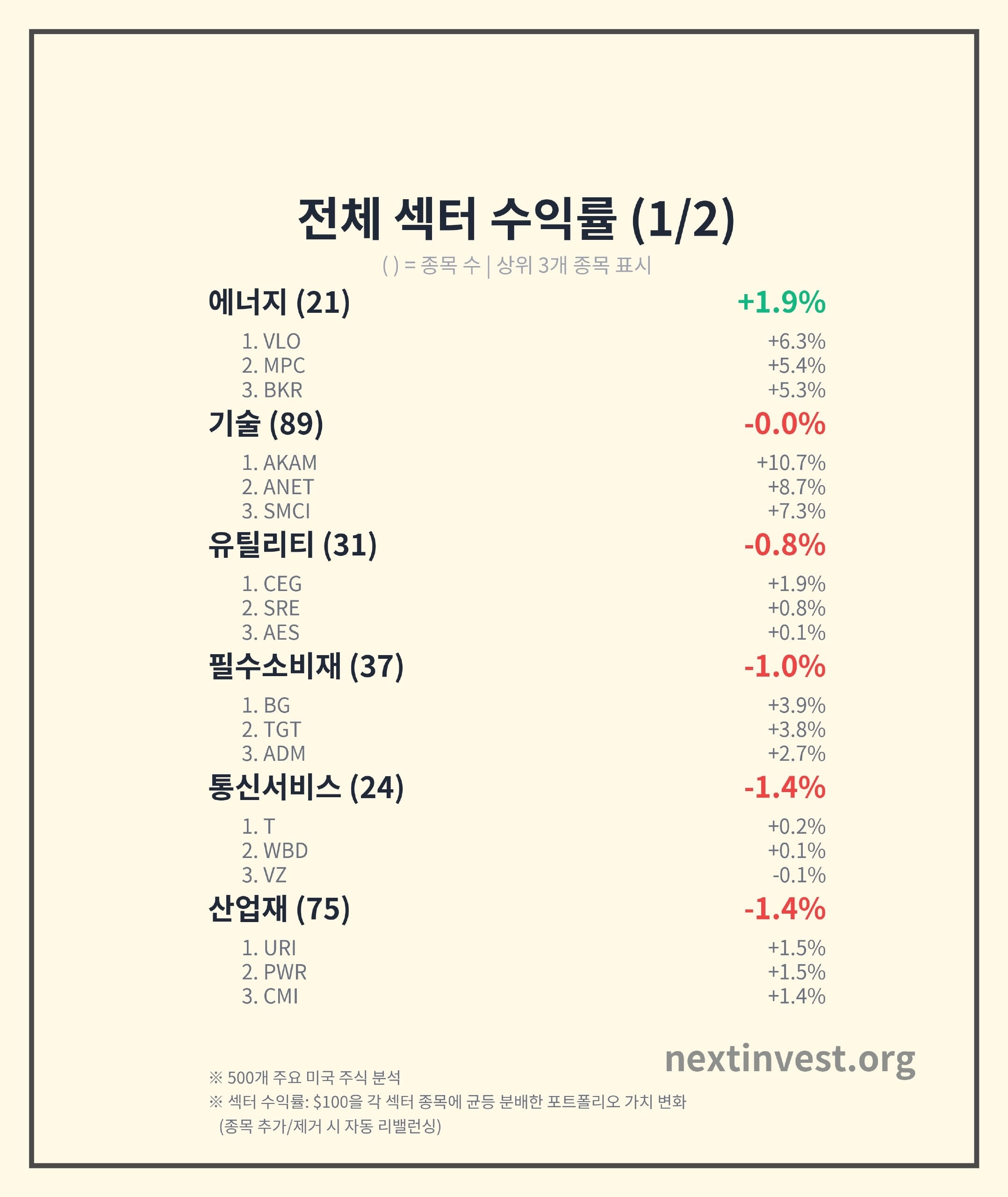
- Today's return: +1.95% (the only positive sector out of 11)
- Representative gainers:
- Valero Energy (VLO): +6.26%
- Marathon Petroleum (MPC): +5.39%
- Baker Hughes (BKR): +5.27%
When oil prices surge by more than 5% in a day, the profit margins and cash flow prospects of refining, drilling, and service companies improve immediately. In cases like today where geopolitical risks are the cause, concerns about "supply disruptions" add to the mix, making energy-related assets move as a kind of 'hedge'. (apnews.com)
Short-term context (7 days):
- After a -1.19% decline on July 1st, a +2.66% gain on July 7th and today's +1.95% mark two consecutive days of strength.
- Even before the escalation of war risks, energy had already been showing increasing volatility, and today this trend exploded.
Mid-term trend (60 trading day analysis):
- Since mid-April, the energy portfolio initially rose by +5~6% but then fell by more than -10% between May and June, effectively returning to near zero total return (+0.09%).
- The situation since July 6th, with a +5% rebound (current regime), suggests that today's surge is a "strong rebound after a long adjustment".
Meaning for investors:
- Investors who already have a high energy weighting will need to tolerate increased volatility due to the short-term surge. A de-escalation of geopolitical risks could also lead to a quick reversal.
- However, since energy has been relatively neglected and adjusted over the past two months, this rally could be the beginning of further recovery (re-rating) from a mid-term perspective.
> As an analogy, imagine a runner who has been lagging behind for a while suddenly speeding up after encountering a 'steep downhill' in the form of war news. If they have stamina left, they can run further, but when the terrain returns to flat ground, their speed will naturally decrease.
---
### 2-2. Technology: Indices are a support, internals are a rollercoaster
- Today's sector return: -0.04% (effectively flat)
- Top gainers:
- Akamai (AKAM): +10.67%
- Arista Networks (ANET): +8.73%
- Super Micro Computer (SMCI): +7.31%
Even as the market was shaken, large growth stocks and AI-related stocks acted as a buffer. The Nasdaq's turnaround is also due to the strength of these individual technology players. (apnews.com)
7-day trend:
- July 1st -0.29%, July 2nd -1.27% for two consecutive days of weakness, followed by a rebound of +1.22% on July 6th, a -0.91% adjustment on July 7th, and almost flat today.
- In a nutshell, it's "swinging up and down but staying near the top."
60-day trend:
- From a baseline of 100 in mid-April, it soared to a high of 133.55 (+33% or more) before entering a weak adjustment phase (-2.4%) in early June.
- The current value of 121.40 still represents a cumulative return of +21.4%, making it the top performer among all sectors.
Why is this important?
- Technology stocks are most sensitive to future growth and interest rates. Even with the war news, the belief that "long-term investment in data and AI infrastructure will continue" has led them to act as a safe haven.
- Companies like Arista and Super Micro are directly connected to AI datacenters and high-performance computing infrastructure. Despite short-term volatility, their structural growth stories remain intact. (tradingkey.com)
Meaning for investors:
- Today's geopolitical event confirmed that even when events like this occur, technology stocks with strong growth stories can act as a buffer against market volatility.
- However, given that these stocks have already risen by more than +20% in the past 2-3 months, further weight expansion should be approached cautiously due to short-term adjustment risks.
---
### 2-3. Financials: Under pressure from interest rates, the economy, and consumer risk
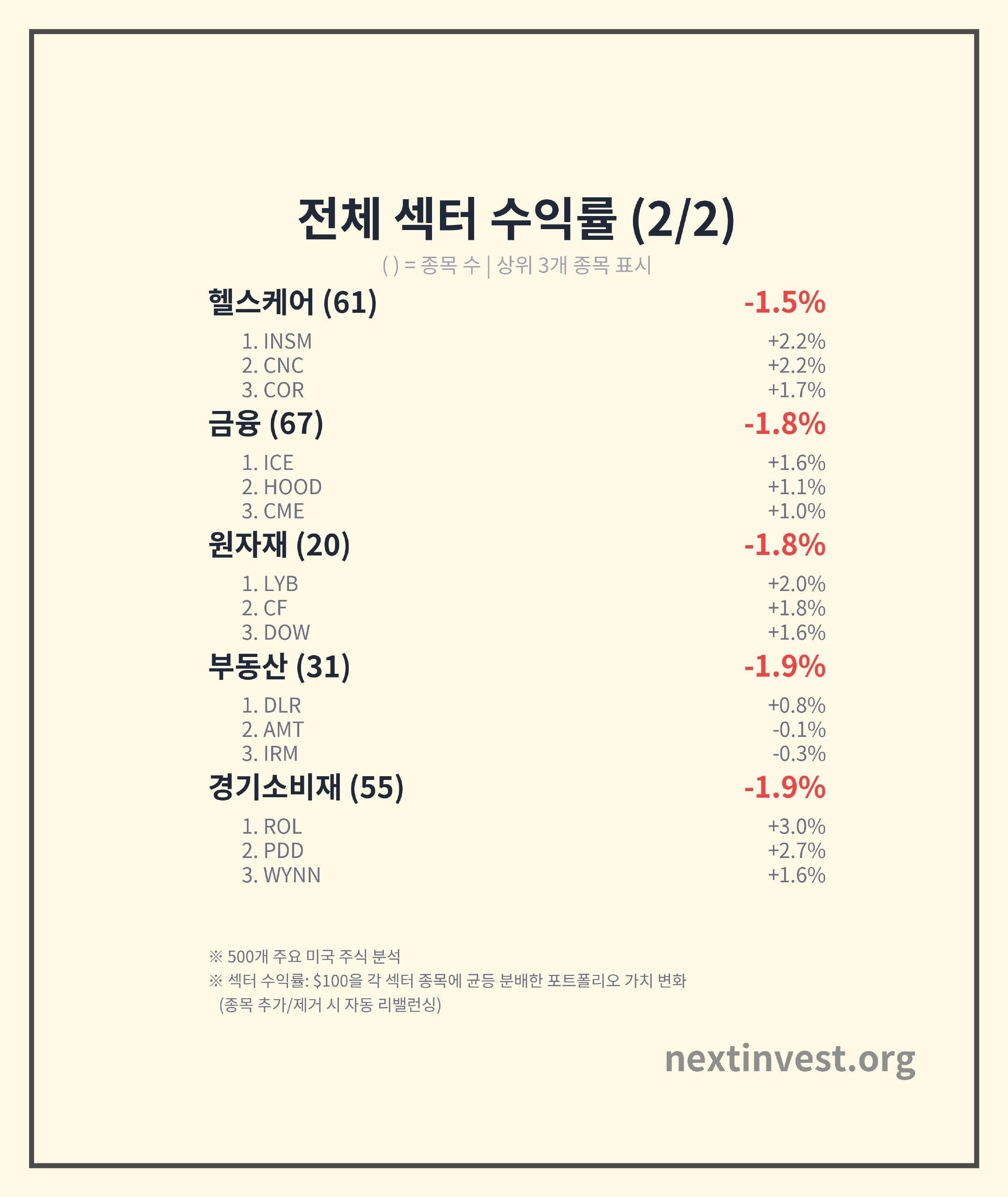
- Today's sector return: -1.81%
- Representative decliners:
- Synchrony Financial (SYF): -9.61% (the most notable decline today)
Financial stocks faced double pressure today.
1. Economic and consumer slowdown concerns
- The surge in oil prices ultimately acts as an inflationary factor that erodes household real income. Companies with large credit card and consumer finance businesses, such as Synchrony, faced increased selling pressure due to questions about "whether consumers can withstand this."
2. Risk-off environment
- When war and inflation concerns rise, the market tends to avoid stocks with high credit risk. Today's sharp drop in SYF reflects not only individual factors but also serves as a symbol of the overall sector weakness.
Recent trend:
- July 1st +2.66%, July 2nd +1.85%, July 6th +0.90%, July 7th +0.11% for four consecutive days of gains followed by a -1.81% plunge today.
- Looking at a 60-day basis, the financial sector rose +9.97% after adjusting -2~3% around mid-April. Today's decline appears to be the first meaningful reversal in this upward trend.
Meaning for investors:
- In the short term, consumer and credit-related financial stocks (cards, retail finance) may be more sensitive to geopolitical and oil price shocks.
- However, the medium-term trend has not completely reversed, but rather appears to be an adjustment on the upward trajectory. If you can tolerate volatility, there is no need to rush to reduce the weight of financial stocks in a long-term diversified portfolio.
---
### 2-4. Consumer, Real Estate, and Cyclical Stocks: Direct Hits from Oil Prices and Interest Rate Concerns
The weakest sectors today were Consumer Cyclical, Real Estate, and Basic Materials.
- Consumer Cyclical: -1.95% (11th out of 11)
- Rollins (ROL): +3.05%, PDD, Wynn, etc., some individual stocks preempted the decline, but the sector as a whole was weak.
- July 6th -0.86%, July 7th -0.17%, today -1.95% for three consecutive days of decline, and still minus -1.35% on a 60-day cumulative basis.
- Real Estate: -1.90%
- As a rate-sensitive sector, it immediately reacted to concerns about rising long-term interest rates and risk premiums.
- After falling -1.08% on July 6th, it rebounded +1.00% on July 7th, but fell again -1.90% today. On a 60-day basis, it has accumulated about +6% in returns, but the recent period is -2.74% in adjustment.
- Basic Materials: -1.83%
- There was a slight rebound until last week, but it is the worst performing sector with -5.21% on a 60-day cumulative basis.
- As global economic concerns grew today, it became a target for risk aversion again.
Reasons why these sectors are weak:
- Rising oil prices can ultimately lead to increased cost burdens for households and businesses → consumption and investment contraction → pressure on earnings of cyclical industries.
- Although interest rates themselves did not move significantly today, the market is already starting to calculate "If inflation is stimulated again, how long will the Fed maintain high interest rates?"
Meaning for investors:
- Excessive concentration in sectors vulnerable to short-term volatility (consumer, real estate, basic materials) can shake the entire portfolio on days like today.
- Basic materials, which have underperformed over the past two months, are also becoming more attractive for long-term valuation, but it is necessary to prepare for further volatility until geopolitical risks are resolved.
---
### 2-5. Defensive Stocks: Healthcare, Consumer Staples, and Utilities Offer Limited Protection Today
Typically, in situations of war or economic slowdown concerns, defensive sectors such as healthcare, consumer staples, and utilities tend to show relative strength. While the decline was relatively moderate today, they did not serve as a complete safe haven.
- Healthcare: -1.53%
- Moderna (MRNA) plunged over 7%, putting pressure on the sector. (apnews.com)
- On a 60-day basis, it has a return of +9.5% and has maintained a moderate upward trend since late June.
- Consumer Staples: -1.00%
- Some, such as Bunge, Target, and ADM, were positive, but the sector as a whole declined.
- However, considering the +1.6% range increase on July 1st and 2nd, and +0.99% on July 7th, it has been relatively stable in recent weeks despite market volatility.
- Utilities: -0.75%
- It had the lowest volatility (Vol 1.17%) and has maintained a solid recovery of +6.86% on a 60-day basis since June 1st.
Meaning for investors:
- Even on days with significant shocks like today, defensive sectors played a role in mitigating losses.
- Maintaining a balanced weight of energy, technology, consumer staples, utilities, and healthcare in your portfolio is crucial for minimizing losses when similar geopolitical events occur in the future.
---
## 3. Today's Big Issue: Iran Risk and Inflation Rekindling Concerns
Today, the single keyword that pierced the market is "Iran War Risk Rekindling."
- President Trump declared that the ceasefire with Iran has ended, throwing fuel on already fragile investment sentiment. (apnews.com)
- Reports continue that the US and Iran have struck over 80 military targets within each other's territories, and concerns have grown about the possibility of this situation escalating beyond mere verbal dispute into actual military conflict. (apnews.com)
The mechanism affecting the market is as follows.
1. Oil Price Surge → Resurgence of Price Pressure
- With Brent crude surging more than 5% and rising to levels hovering around $80, future increases in energy and transportation costs are becoming a certainty. (apnews.com)
- This means it could stimulate the Consumer Price Index (CPI) again, and ahead of the next CPI release scheduled for July 14, it is making investment sentiment even more sensitive. (reddit.com)
2. Re-evaluation of Inflation and Interest Rate Path
- If inflation strengthens again, the market will ask anew: "When and how much can the Fed cut rates?"
- Until recently, expectations of rate cuts in the second half of 2026 had been gradually reviving and supporting the stock market, but an oil shock like today's is an event that raises a question mark over that scenario. (ftportfolios.com)
3. Re-evaluation of Risk Assets Overall
- With geopolitical risks compounding, investors moved into energy, defense, and some safe assets,
- and showed a flow of exiting cyclical stocks, consumer-related stocks, and some high-risk tech stocks.
> In simple terms, today was a day the market asked itself: "Were we perhaps too optimistic?"
---
## 4. Short-term vs Mid-term: How to Interpret Today?
### Short-term (Around 1 Week) Perspective
- Energy: Strong rallies for two consecutive days have amplified short-term overheating signals. Depending on the flow of geopolitical news, significant volatility could continue in both directions.
- Technology: Maintaining the upper band of a trading range amid up-and-down swings continuing from last week. Today it contributed to defending indices, but could become a target for profit-taking if overall risk aversion intensifies.
- Finance, Consumer, Real Estate: While sentiment hasn't shifted from optimistic to pessimistic in just one day, the addition of a new variable—"rising oil prices + war risk"—has damaged short-term momentum.
### Mid-term (2-3 Months) Perspective – Position Based on 60-Day Trends
Based on the 60-day sector portfolio analysis you provided:
- Technology, Healthcare, Finance, Real Estate, and Staples are still positioned in cumulative gains of +5-20%, and despite today's adjustment, can be viewed as noise above an uptrend.
- Energy has recently undergone adjustments in the -10% range and is just beginning to rebound; whether today's rise marks the start of a trend reversal or is a temporary bounce followed by re-adjustment needs to be watched over the coming days in terms of oil price and news flow.
- Basic Materials and Discretionary Consumer are still in negative territory on a 60-day basis,
- confirming once again that these are the sectors sold off first in risk-off periods due to their sensitivity to economic cycles, Chinese demand, and commodity prices.
---
## 5. What Does This Mean for Me? – Practical Implications
Finally, let me summarize the points individual investors should consider after observing today's market.
### 5-1. Managing "News Risk" Through Portfolio Structure
Situations where a single political comment shakes global asset prices, like today, will continue to repeat.
- Individual stock selection is important, but
- Mixing sectors with different economic sensitivities—such as energy, technology, defensive sectors, financials, and consumer—is a defensive strategy in the big picture.
Looking at today's data:
- Energy played a hedging role, holding the portfolio up amid index declines,
- Consumer staples, utilities, and healthcare acted as buffers, reducing the magnitude of declines,
- Technology served as psychological support through its long-term growth story.
### 5-2. Not Swayed by Short-Term Spikes and Drops
- Stocks like SYF that move 8–10% in a single day see volatility double when the sector and macroeconomic environment deteriorate. Today is a case where overall market risk-off sentiment combined with structural concerns about consumption and credit. (marketbeat.com)
- Energy stocks' rally was also triggered by non-economic factors like war risk, so the timing of profit-taking and risk management is critical.
### 5-3. Upcoming Events: Inflation Data and Central Banks
- The market already sees the U.S. CPI, scheduled to be released on July 14, as the next major inflection point. (reddit.com)
- How much today's oil price surge will impact inflation over the next 1–2 months,
- And depending on how seriously the Fed treats "oil-driven inflation",
- Interest rate expectations,
- Growth stock valuations,
- And reassessment of cyclical sectors could follow.
---
## 6. Closing: Summing Up Today in One Sentence
> "War news shook the market, but the power of structural growth and diversified investment remained effective today"
Energy stocks directly benefited from war risk, technology and defensive sectors mitigated market volatility, while financials, consumer, real estate, and materials stocks took the brunt of risk-off sentiment.
In the coming days, news headlines and oil price movements will likely continue to drive the market. However, even amid today's volatility, it was a day that clearly showed how sector correlations and diversification effects work.
For long-term investors, treat days like today with sharp rallies and drops as a "portfolio strength check day,"
- Which sectors are excessively increasing your risk,
- Which sectors are absorbing shocks
and review accordingly.
This content is provided for informational purposes only and does not constitute investment advice for any specific securities or assets.
Source: https://nextinvest.org/ko
Feel free to share without permission ^^