8/17 US Stock Market-Wall Street Shaken by Oil Surge and Rate Shock, Only Energy Gains
August 17, 2026 Market Analysis
## 1. What Happened Today?
On Monday, August 17, the US stock market closed lower again, retreating from record highs.
- All major indices closed in decline
- Dow Jones: down approximately 0.5%
- Nasdaq: down approximately 0.3% (apnews.com)
- Overall, it was a day when the "risk-on appetite" cooled down a notch.
- Energy was the only sector with a clear gain, while communications, consumer, and real estate sectors experienced relatively sharp corrections.
The backdrop is simple.
1. Oil prices rebounding again, reigniting inflation concerns
2. Long-term Treasury yields surging to their highest levels since the mid-2000s
3. As a result, growth stocks, high-valuation stocks, and defensive stocks all came under pressure, leading to broad-based corrections. (apnews.com)
The key point from your perspective is:
> Today's decline is not so much because "earnings suddenly deteriorated," but rather a signal that macroeconomic variables like oil and rates have returned to the center of market attention.
## 2. Today's Numbers at a Glance
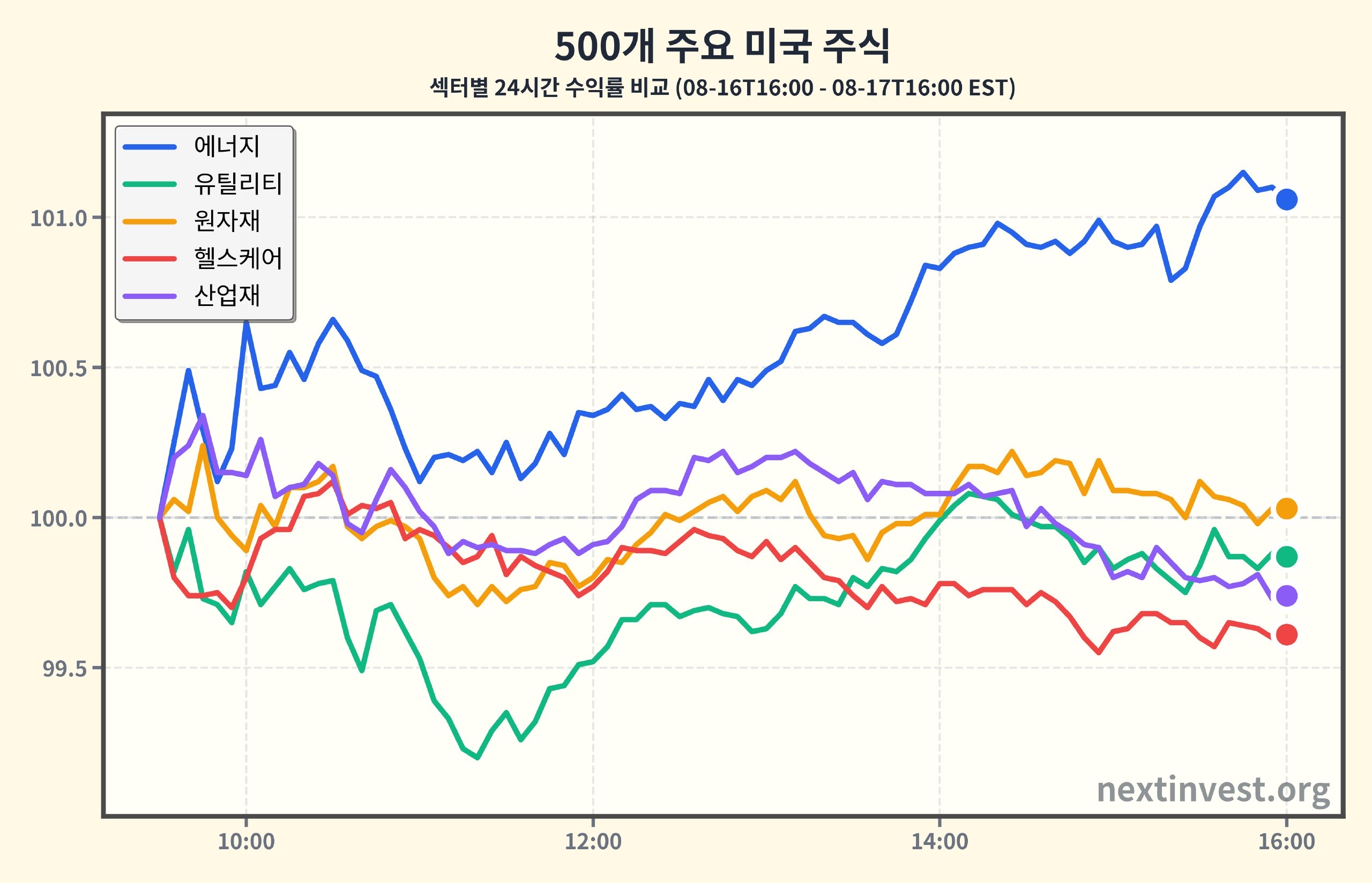
Summarizing the 24-hour (24H) sector performance available to us:
- Market sentiment: Overall negative (Risk-off)
- Out of 11 sectors, gainers: 1 (Energy)
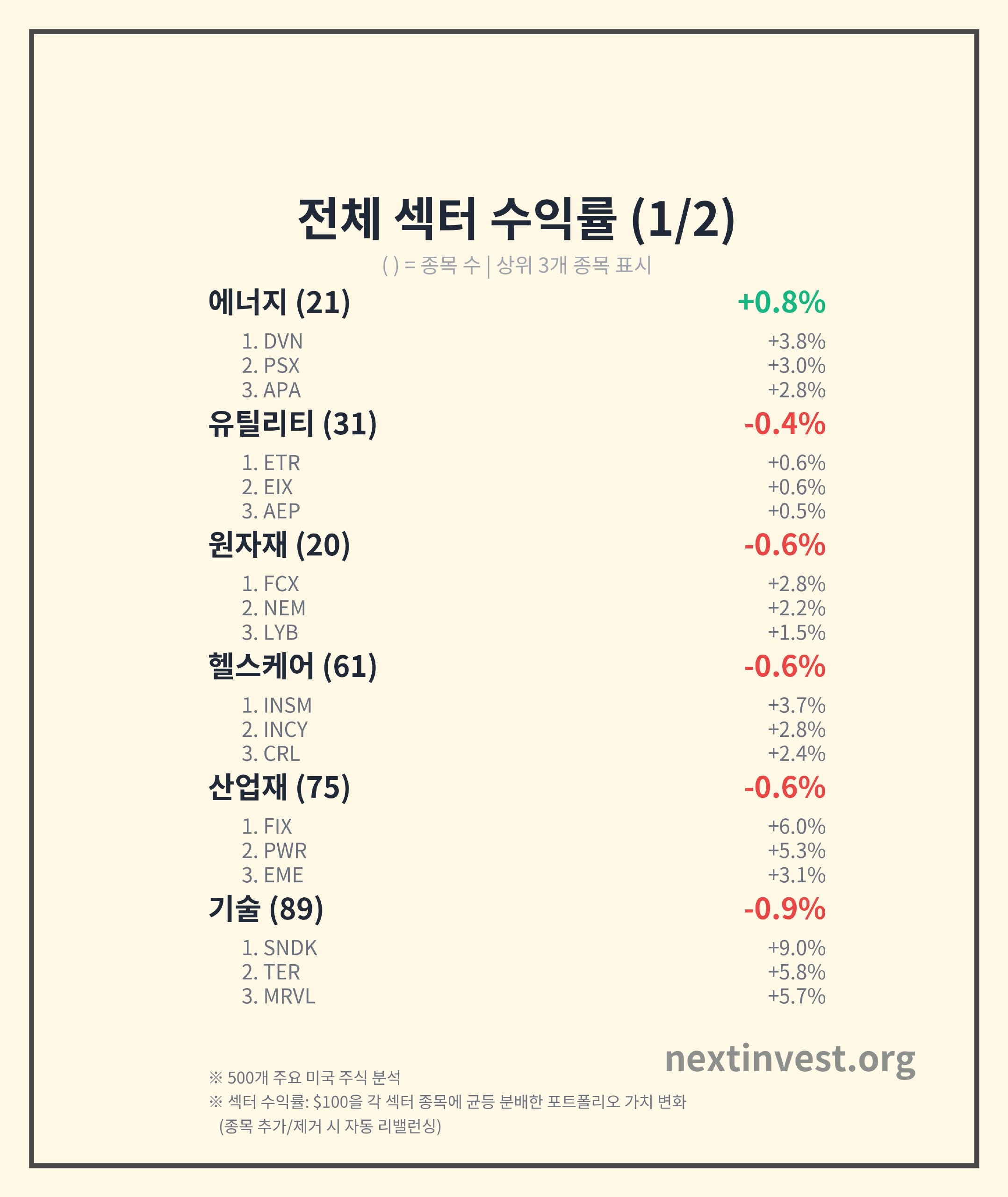
- Leader: Energy +0.81%
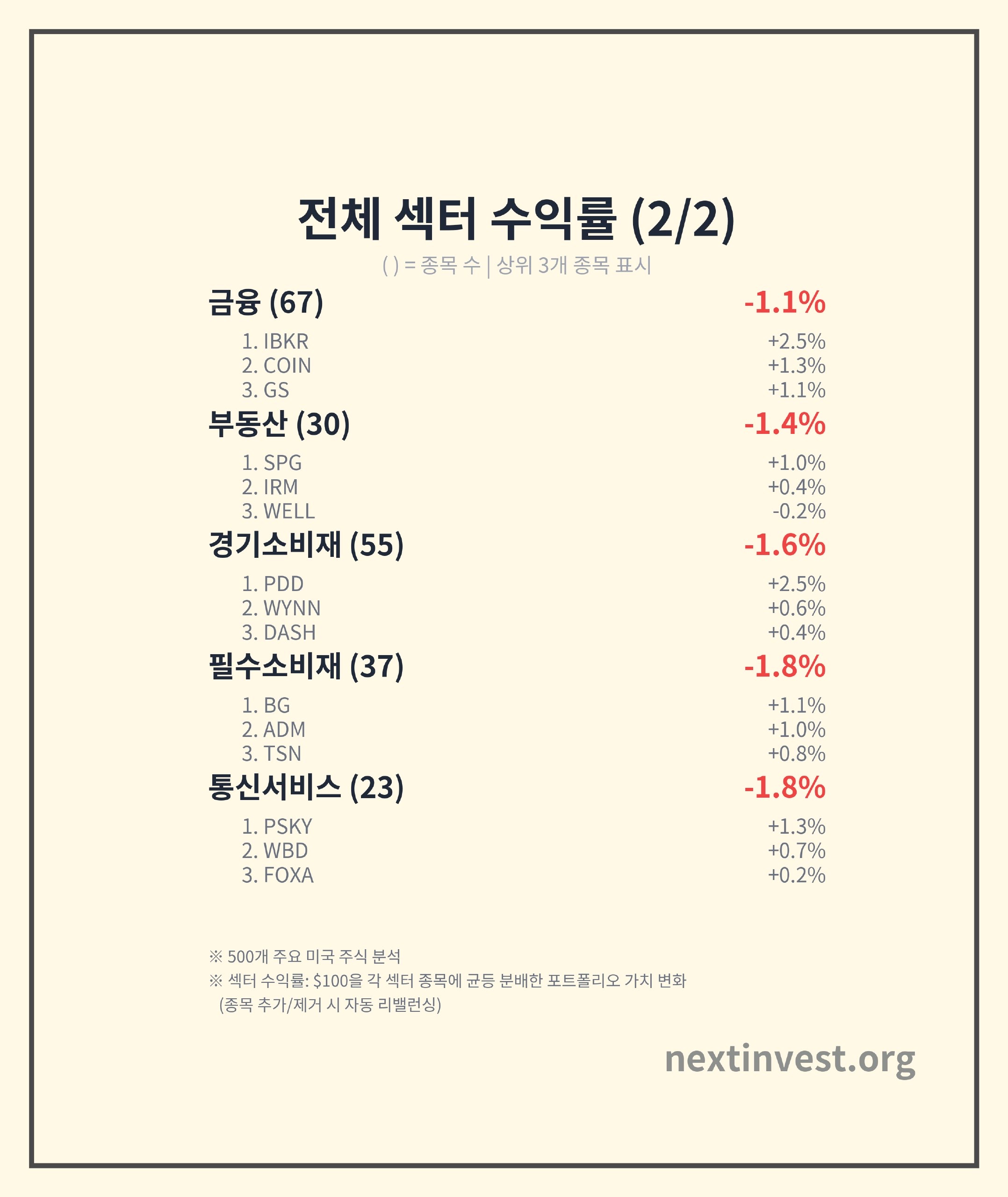
- Weakest: Communication Services -1.83%
Looking at the 7-day trend (based on recent trading days):
- Energy: From late last week onward, +1.26%, +1.67%, and +0.81% today, gaining 3 out of 3 trading days → direct beneficiary of oil rebound
- Communication Services: showed a bounce with +2.41%, +0.86% previously, but gave back -1.83% today
- Consumer (discretionary and essential): showed small gains in previous days, but failed to defend with -1.61%, -1.77% respectively today
- Technology: showed strength with +0.83%, +2.16% over the previous 3 trading days, then paused with -0.92% today
In other words, the 'risk-on and growth stock strength' pattern that had continued through late last week came to a temporary halt today due to the oil and rate shock.
## 3. Two Variables That Shook Today's Market: Oil and Rates
### 3-1. Oil Surge — Only Energy Gained
Today's biggest news is the rebound in global oil prices. As Brent crude rallied back to the mid-to-high $80s per barrel, the market began calculating "inflation pressures" once again. Some reports point to heightened Middle East tensions and Iran-related uncertainties as the backdrop for the oil rebound. (apnews.com)
This trend aligns almost perfectly with today's sector performance.
- Energy Sector:
- 24H Performance: +0.81% (1st out of 11 sectors)
- Notable Stocks:
- Devon Energy (DVN): +3.75%
- Phillips 66 (PSX): +2.97%
- APA Corp (APA): +2.79%
- 7-day Momentum: +1.67% on August 14, +0.81% today — two consecutive days of robust gains with oil
What matters more than the direction is the 'cause.'
- Oil price rise → Refining, exploration, and production companies' margin expectations increase → Energy sector stock prices ↑
- At the same time, oil price rise → Possibility of future inflation index rise → Weakening of expectations for interest rate cuts by central banks → Burden on other sectors
Meaning for investors:
- For investors who already had a certain proportion of energy, it was a day that played a role in protecting their portfolio.
- However, looking at the mid-term trend over the past two months or so, the energy sector fell by -8.96% at one point after the end of May, but has shown a steep rebound (+10% or so) since July. Considering that it has risen by +9.34% in just the last 8 days since August 7th, it is important to keep in mind that today may be in the middle to late stage of a mid-term rebound.
> In summary: The energy sector laughed thanks to the oil price shock, but since it has already recovered significantly in the mid-term, "late pursuit buying" carries the risk of volatility.
### 3-2. Sharp Rise in Long-Term Interest Rates — "Heavy Air" Weighs on Growth and Defensive Stocks
Another key point today is that the yield on the US 30-year Treasury bond soared to its highest level since 2007. (apnews.com)
This means that the market is interpreting it as follows.
- "Inflation may last longer than expected."
- "The Fed (Federal Reserve) may not rush to cut interest rates."
Why are rising interest rates bad for stocks?
1. Increase in discount rate for future earnings: Especially for companies like tech companies that have high expectations for "future earnings," their value is theoretically reduced more when interest rates rise.
2. Increased relative attractiveness of bonds: For example, if a 30-year Treasury bond yields 5%, some investors may feel that "the need to hold volatile stocks has decreased."
Today's flow reflects this well.
- Technology sector:
- Today: -0.92% adjustment
- However, the previous three trading days were +0.83%, +2.16%, etc., showing strength
- Looking at the 60-day mid-term trend, it has entered a rebound range of over +10% since the end of July — today can be seen as the first meaningful pause in that rally.
- Communication services:
- Today: -1.83% (worst sector)
- In the mid-term rebound phase of +7% or more since the end of July, profit-taking pressure on volatile media and communication stocks appeared all at once today.
> Intuitively, it can be understood as "interest rates are rising, so the premium for growth stocks is being re-evaluated."
## 4. Sector Characteristics and Trends Today
### 4-1. Energy: Oil Price Rise Creates a 'Short-Term Winner'
- Today: +0.81%
- 7-day flow: -0.21%, -0.01% adjustment since August 11th, followed by two consecutive days of strong gains
- 60-day trend: Experienced a deep correction of -8~9% until the beginning of July, but rebounded by over 10% since July, and the section since August 7th has been +9.34%, which is very steep.
Investor perspective:
- Energy has served as a "hedge (defense)" against inflation and geopolitical risks throughout the year.
- However, this sector is highly volatile and heavily dependent on oil price outlook, so it's important to adjust your weighting during periods of rapid rise.
### 4-2. Technology: Mid-Term Trend Still 'Upward', Today a Temporary Pause
- Today: -0.92%
- 7-day flow: +0.83%, +2.16% strong rally in the middle of last week, followed by -0.70% on Friday and -0.92% today for two consecutive days of adjustment
- 60-day trend:
- After a high in early June, it fell by almost -10%,
- Rebounded +10.58% from July 27th to today — a clear mid-term "recovery phase"
- Today's strong stocks:
- Sandisk (SNDK): +9.02%
- Teradyne (TER): +5.81%
- Marvell (MRVL): +5.72%
This shows that expectations for AI/data-related demand, including semiconductors and storage, are still alive. However, the sector as a whole has not been able to escape the headwinds of rising interest rates.
Investor Perspective:
- Tech stocks have a long-term growth story intact, but they are the most sensitive sector to macro variables such as interest rates and oil prices.
- After a rapid rebound of more than 10% over the past three weeks, a short-term adjustment may be inevitable "speed control."
- Long-term investors can use days like today as an opportunity to "buy good stocks at a slightly cheaper price," but short-term traders should be wary of increased volatility.
### 4-3. Finance: Interest Rate Tailwinds vs. Economic and Market Risks
- Today: -1.07%
- 7-day flow: Three out of the last four days were slightly positive, but today's decline wiped out those gains.
- 60-day trend: +12.66% since late May, a solid upward trend, especially with an additional gain of over 4% since early July.
- Today's relative strength stocks:
- Interactive Brokers (IBKR): +2.47%
- Coinbase (COIN): +1.35%
- Goldman Sachs (GS): +1.14%
While rising interest rates theoretically benefit banks by widening net interest margins,
- simultaneously, growing stock market uncertainty and concerns about an economic slowdown lead to fears of decreased loan demand and increased credit risk.
- This results in a mixed picture today, with the sector as a whole weakening while some trading and brokerage stocks show strength.
Investor Perspective:
- Financial stocks have shown a "steady upward trend" over the past two to three months, and today's decline can be seen as a natural pause due to macro uncertainty.
- If long-term bond yields rise too quickly, it could actually increase the risk of an economic recession. Therefore, it is too early to simply view "interest rate↑ = financial stocks unconditionally bullish."
### 4-4. Consumer Discretionary, Real Estate and Communication: Direct Hits from Interest Rates and Economic Sensitivity
- Consumer Cyclical: -1.61%
- Representative Weak Stocks: Carvana (CVNA) -7.17% etc.
- The mid-term trend is +6.65% since May, which is not bad, but it has entered a -2.45% adjustment phase since August 11th.
- Consumer Defensive: -1.77%
- Constellation Brands (STZ) -6.19% etc., some stocks were heavily pressured
- In the medium term, there is a moderate upward trend of +5.92%, but today shows that even "defensive stocks" can fail to act as shields when interest rate and price uncertainties arise simultaneously.
- Real Estate: -1.36%
- Direct hit from rising interest rates — increased financing costs, decreased present value of rental income, etc.
- A -3.78% adjustment phase has been underway since late July, and today's decline continues that trend.
- Communication Services: -1.83% (worst performing sector)
- Charter (CHTR) -6.79% etc., stocks with high leverage and growth expectations are the first to be dragged down in a rising interest rate environment.
Investor Perspective:
- These sectors are characterized by being "interest rate sensitive + economically sensitive."
- Therefore, in a combination of a sharp rise in long-term bond yields and rising oil prices, today's simultaneous weakness is not unusual but rather a textbook reaction.
### 4-5. Healthcare and Utilities: Defensive Sectors Are Not Perfect Havens
- Healthcare: -0.63%
- In the medium term, it has recorded a top-tier return of +14.73% since May, and has been on an upward trend of over 5% since July 21st.
- Today's slight adjustment is due to profit-taking following recent strength and a general risk aversion sentiment.
- Utilities: -0.37%
- It had been on a short-term rebound of +2.27% since August 10th, but today's weakness is due to pressure on dividend stocks from rising interest rates.
Investor Perspective:
- Often called "defensive sectors," but in times of rapidly rising interest rates, dividends and regulated industries can actually be pushed back by bonds due to their characteristics.
- However, compared to growth and consumer stocks that have risen significantly over the past 2+ months, healthcare and utilities differ in that they are adjusting from relatively less overheated levels.
## 5. Connecting Today's Market to the Past 2 Months
Summarizing the mid-term (approximately 60 trading days) trends by sector seen above into one line:
- Clear mid-term uptrend: Healthcare, Finance, Technology, Energy, Consumer Staples
- Slow recovery or range-bound: Materials, Industrials, Real Estate, Utilities, Communication Services
Today's market was:
1. A day when growth, consumer, communication, and real estate sectors—which have already risen significantly—entered "pace adjustment" as interest rates and oil prices surged again
2. A day when energy, which had lagged in the mid-term, emerged as a short-term leader on the back of rising oil prices
is a natural way to understand it.
> In other words, August 17 is closer to "a day when health checks on growth, consumer, communication, and real estate—which have led the market throughout the first half of this year—have resumed" rather than "the rally has completely ended."
## 6. Checkpoints for Individual Investors
### 6-1. Three Portfolio Review Questions
1. "How is my portfolio exposed to oil price and interest rate scenarios?"
- If your energy allocation is minimal, you may lack sufficient inflation hedging during oil price rallies like this one.
- Conversely, if you have already accumulated significant energy exposure, volatility management is necessary given that the mid-term recovery has already progressed substantially.
2. "Is your allocation not excessive to stocks most vulnerable to rising interest rates (high-dividend, high-leverage, high-valuation growth stocks)?"
- Communication, real estate, and some high-growth stocks are typical examples.
- These can be the first to shake and the most severely impacted during periods of rapid long-term Treasury yields rises.
3. "Are you distinguishing between mid-term trends and today's daily movements?"
- Technology, healthcare, and finance are still on an uptrend on a 60-day basis.
- Rather than seeing today's decline and pursuing a sell-off, it's important to view today's position objectively within the context of the recent 2-month trend.
### 6-2. Practical Action Ideas You Can Take Now
Please view these as a checklist for review rather than investment advice.
- ① Diversify risks:
- By mixing sectors that respond differently to macroeconomic variables, like energy, healthcare, and finance, you can reduce overall portfolio volatility even on days when specific factors (oil prices, interest rates) dominate, as today.
- ② Capitalize on 'healthy corrections' in mid-term uptrend sectors:
- When sectors like technology and healthcare, which are still in an uptrend on a 60-day basis, experience adjustments of around 1% like today, they can be candidates for scaling-in purchases for long-term investors.
- ③ Differentiate between overheated and underheated periods:
- Energy has been in a steep rebound phase over the past month,
- while communication and real estate are still in a state where mid-term recovery has not fully established.
- Rather than unconditionally chasing top-performing sectors over the past 2 months, it's better to adjust allocations by viewing each sector's mid-term position alongside today's volatility.
## 7. Closing: One-Line Summary of Today's Market
> Today (August 17), the U.S. market saw oil prices and long-term interest rates surge simultaneously, marking a day when "inflation and interest rates" re-emerged as the main issue.
>
> Energy gained, while growth, consumer, real estate, and communication sectors collectively caught their breath, entering an adjustment period where the rally's pace is being reassessed following record highs.
The market is likely to remain most sensitive to oil price trends and long-term Treasury yields in the coming days. Now is a good time to review your portfolio once more, focusing on whether its structure can withstand these two variables.
This content is written for informational purposes only and does not recommend investment in any specific stocks or assets.
Source: https://nextinvest.org/ko
Free to share ^^