Four months ago, AI was about the level of ChatGPT a year ago or Gemini used on the web.
It could provide approximate translations, create sets of Linux commands, and perform basic coding tasks within the scope of a webpage.
Four months ago, I thought it would be great to create a program using AI. Without any particular plan, I started working on implementing it.
At that time, the level was such that I could give Python input to Gemini's window and get calculated results as code output.
Of course, I had done some basic coding myself, but since AI could create it faster, there was no reason not to use it.
The problem arose as the code grew longer with each added function.
When it exceeded 2000 lines, Gemini's website couldn't read the entire Python file.
As I continued to divide and update the code by functionality, it exceeded 10 files, reaching a point where Gemini could not handle it in a single chat session.
Searching for a service that could handle this led me to Claude. Even with free sessions, I was able to upgrade it somewhat and ended up subscribing to the Pro plan due to its limitations in the free version.
The model used at the time was Opus 4.8, and I would say it was a whole new world.
At least for coding, I thought that this level of coding was sufficient for my needs. Recently, DGX SPARK-compatible local models are still not perfect, but seeing them catching up to Opus 4.8 gives me hope for significant improvements next year.
Anyway, after subscribing to Max x5 for two months and ChatGPT Plus for one month (totaling three months excluding overlaps), I purchased codex, a CLI tool, and experienced another breakthrough. I've been experimenting with various things ever since.
In the meantime, feeling the limitations of censorship and capabilities in commercial AI, I purchased two DGX SPARKs (each €3500) for fine-tuning and local model deployment. They are still being used effectively.
Anyway, I'm going to summarize the code I aimed for and some minor details that were impossible for me to achieve on my own.
I don't think I'll need another subscription to a cloud service unless a significantly better model emerges or a major development requires it.
Self-made program - The key point that led me to subscribe for four months and the reason I'm writing this. Functionality additions exceeded my expectations, and through Sol and Fable reviews, I was able to fix a significant number of bugs. It reached a decent level (the actual source code is worth more than twice the investment in DGX SPARK purchase). Some parties are even interested in purchasing the entire source code, but I'm still considering whether to distribute or sell it - it directly relates to my professional competitiveness.
The entire code, which started as a chat window on Gemini, has grown into a program with 247 files and 176,141 lines.Android app modification - This involved two apps whose services and support had been discontinued. I requested AI to modify the APK files to be compatible with newer Android versions and add functionality tailored to my usage patterns. While I can't disclose the names, I modified a community viewer app and a video player app, both of which are now installed and working well on my phone.
Three new Android apps created - App A connects a phone to Termux to execute Python code. App B manages services and system status checks running on DGX SPARK. App C is called pcodex, a modified version of the openai codex app adapted for my DGX SPARK LLM.
Modified desktop app - The aforementioned pcodex CLI client app. I forked and modified the source code from GitHub to be compatible with DGX SPARK and implemented mobile integration.
Firefox extension - Created a new extension for my personal server. It's not overly complex, but it can generate an extension with just two commands (with a time interval between the commands for key generation).
Porting an Android app to macOS - I had an Android app that was incredibly useful, but it was quite resource-intensive. When I asked AI to port the APK file to macOS, it managed to implement about 80% of the functionality. (The remaining 20%, with 10% implemented through a local LLM.) Using Opus for this purpose could potentially lead to legal issues.
Modifying Qwen3.8 flash next for Windows - This involved modifying an outdated program whose source code was unavailable and hardware support had been discontinued. I needed to remove the limitations, but disassembling the program required expertise that commercial AI couldn't provide. Using DGX SPARK with a censorship-free LLM model, I managed to resolve this issue in about a week. It wasn't perfect, but it restored essential functionality.
Final touch - Fixing Korean font display issues on an R36S emulator purchased from AliExpress. Using a CLI code app, I patched the ROM image to fix the font rendering issue. The app successfully identified and applied a Korean font patch.
The core program (item 1) now takes over 10 hours for a single cycle verification, so I've been using the remaining sessions to create and modify various things.
With only ten days left on my subscription, I'm happily pondering what to do with the remaining sessions.
Seeing how much I was able to accomplish in a few months leaves me both thrilled and somewhat melancholic.
Given the rapid pace of AI development, I'm starting to worry about whether I'll be able to maintain my position in 4 or 5 years.
For now, I'm concluding my AI subscription and reflecting on this experience.
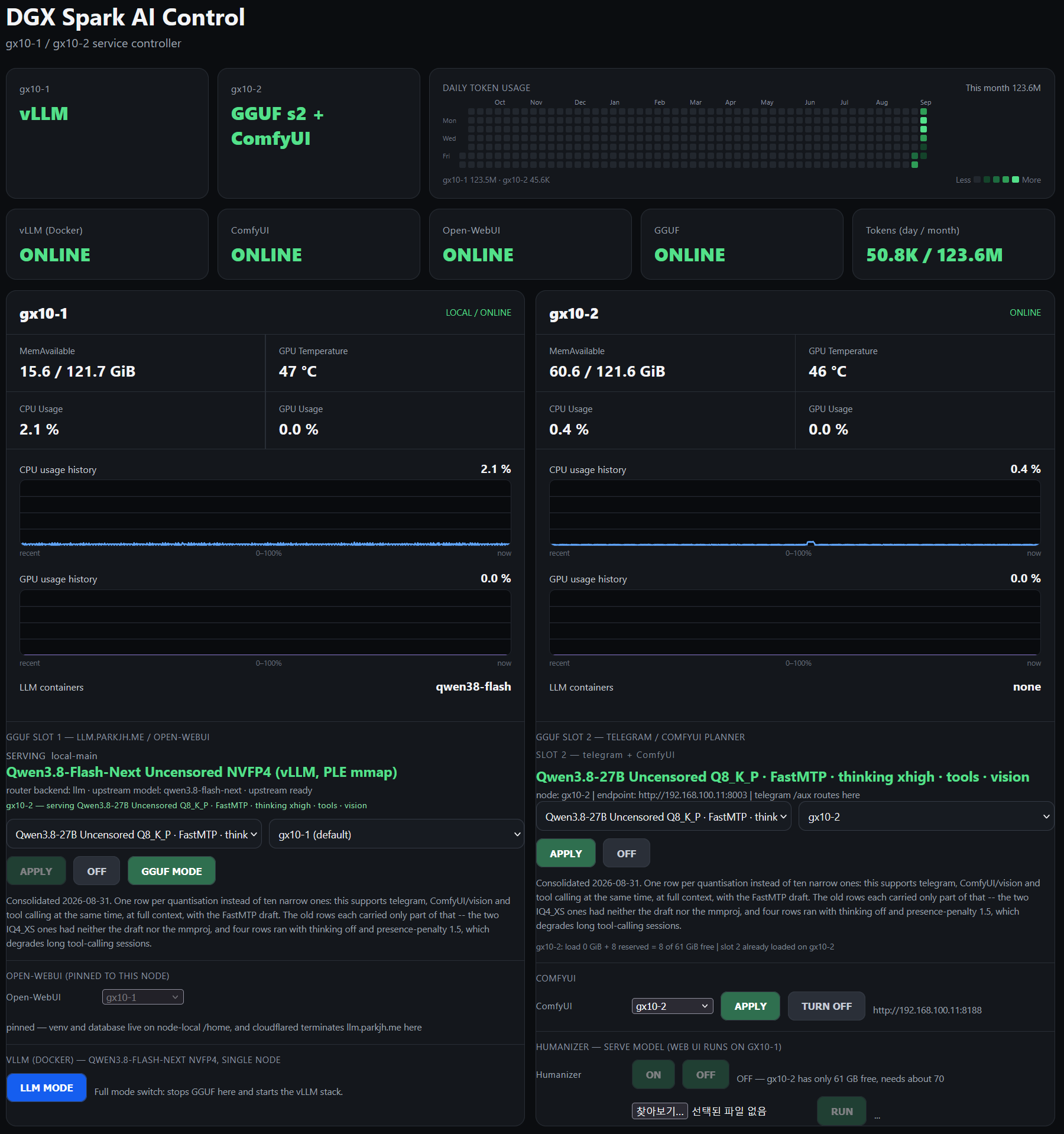
This is the current state of my service management page, which has been further refined with token counters and other features.
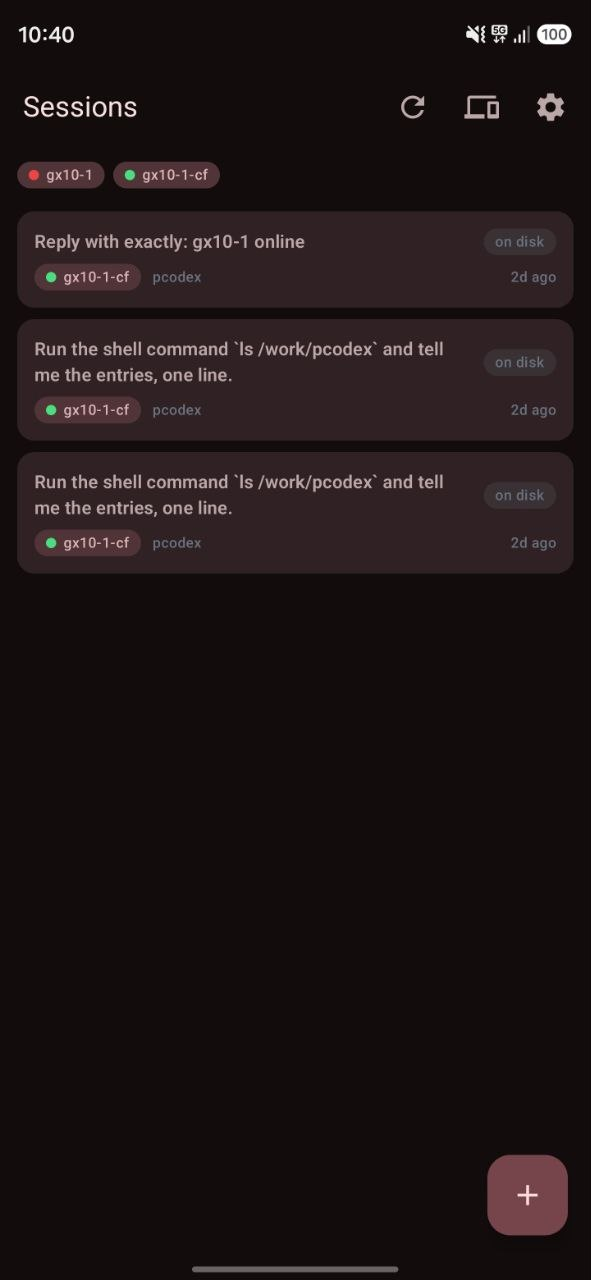
This is a mobile app that allows you to view and manipulate pcodex sessions using the LLM connected to DGX SPARK. It supports Cloudflare and Tailscale connections.

