6/17 US Stock Market - Fed's Hawkish Signal Sends US Stocks Plummeting... Tech and Real Estate Hit Hard
June 17, 2026 Market Analysis
## 1. Why Did the US Market Fall Today?
Today (June 17th), the US stock market was hit hard all day by "Fed shock."
- S&P 500: -1.2% decline【(apnews.com)
- Dow Jones: -1.0% decline【(apnews.com)
- Nasdaq Composite: -1.3% decline【(apnews.com)
Until yesterday, the market had been engaged in a tug-of-war over "when the first rate cut will come," but today it suddenly faced a signal that "a rate hike could happen this year."
- The Fed FOMC dot plot showed that 9 out of 18 members expect at least one rate hike this year【(apnews.com)
- The first press conference by new Chair Kevin Wash was received with a sense of uncertainty ("hawkish but ambiguous message") and froze investor sentiment【(apnews.com).
Key Points:
> The market had been betting on "rates coming down someday," but today the scenario of "rates possibly going up" suddenly appeared on the table.
As a result, growth stocks and high-value stocks were hit first, followed by almost all sectors ending the day down.
---
## 2. Sector Snapshot – “All 11 Sectors in the Red”
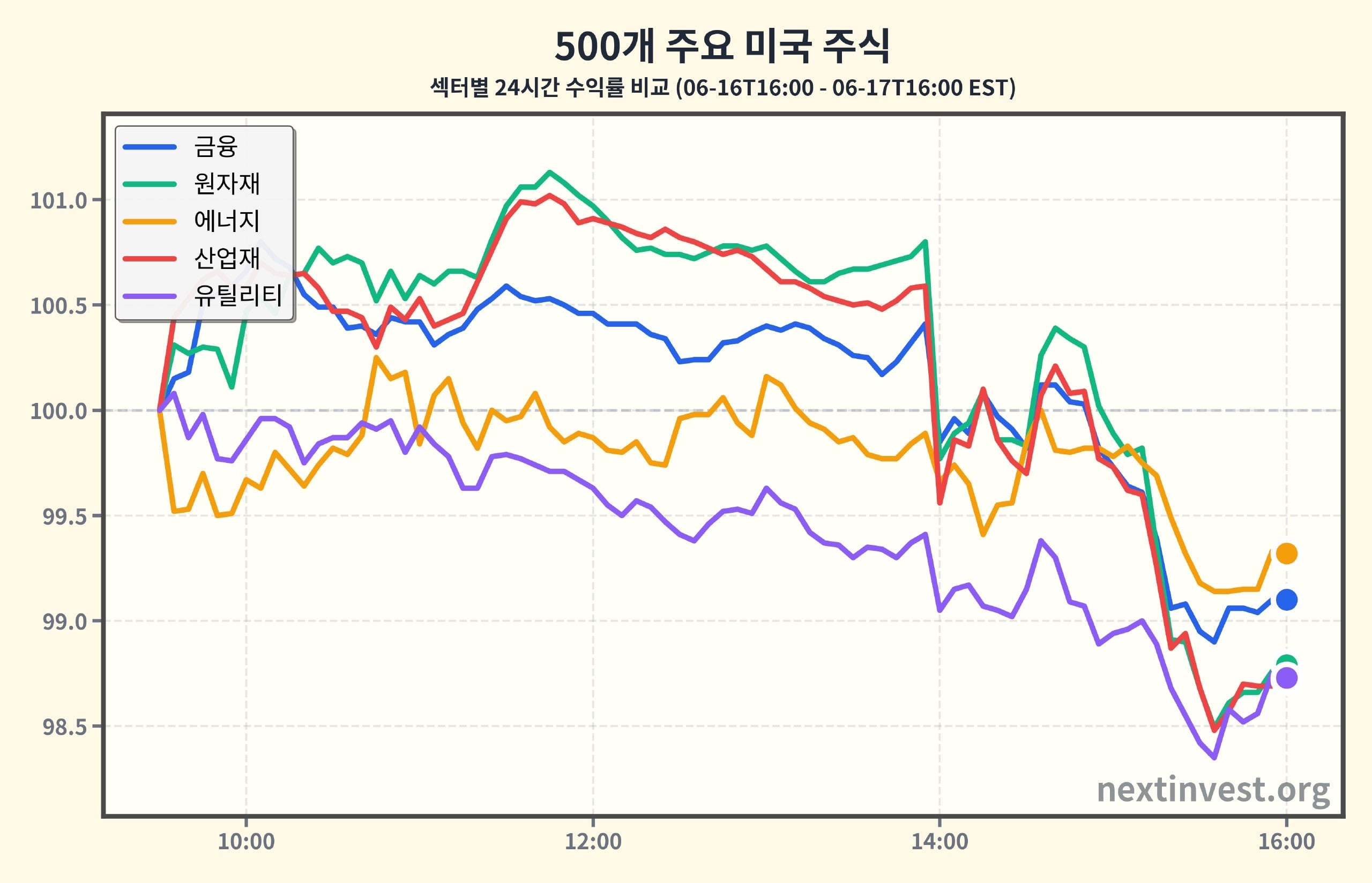
Based on the 24-hour sector performance summary provided today, all 11 sectors declined.
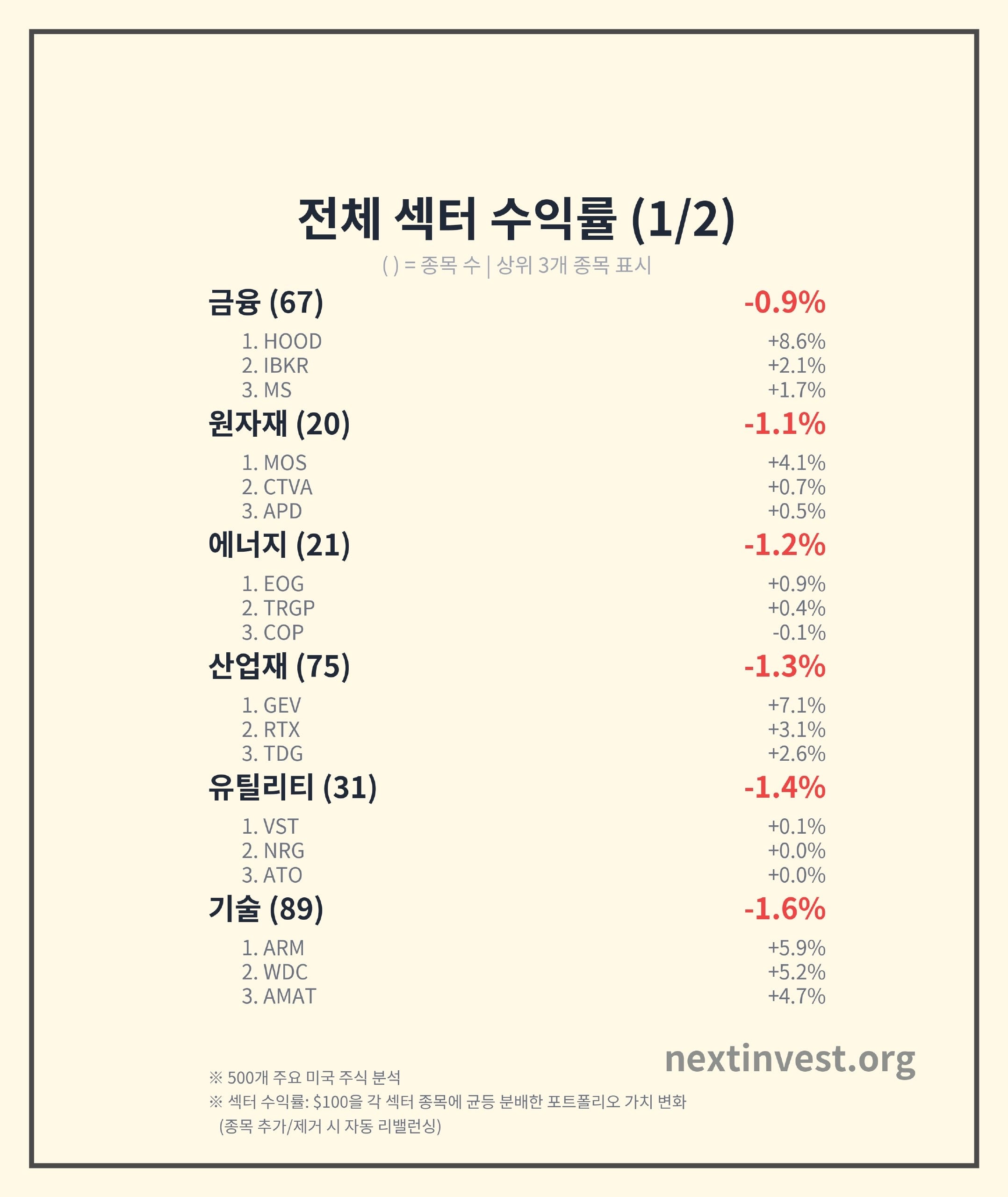
- Sector with the smallest decline: Financials (-0.90%)
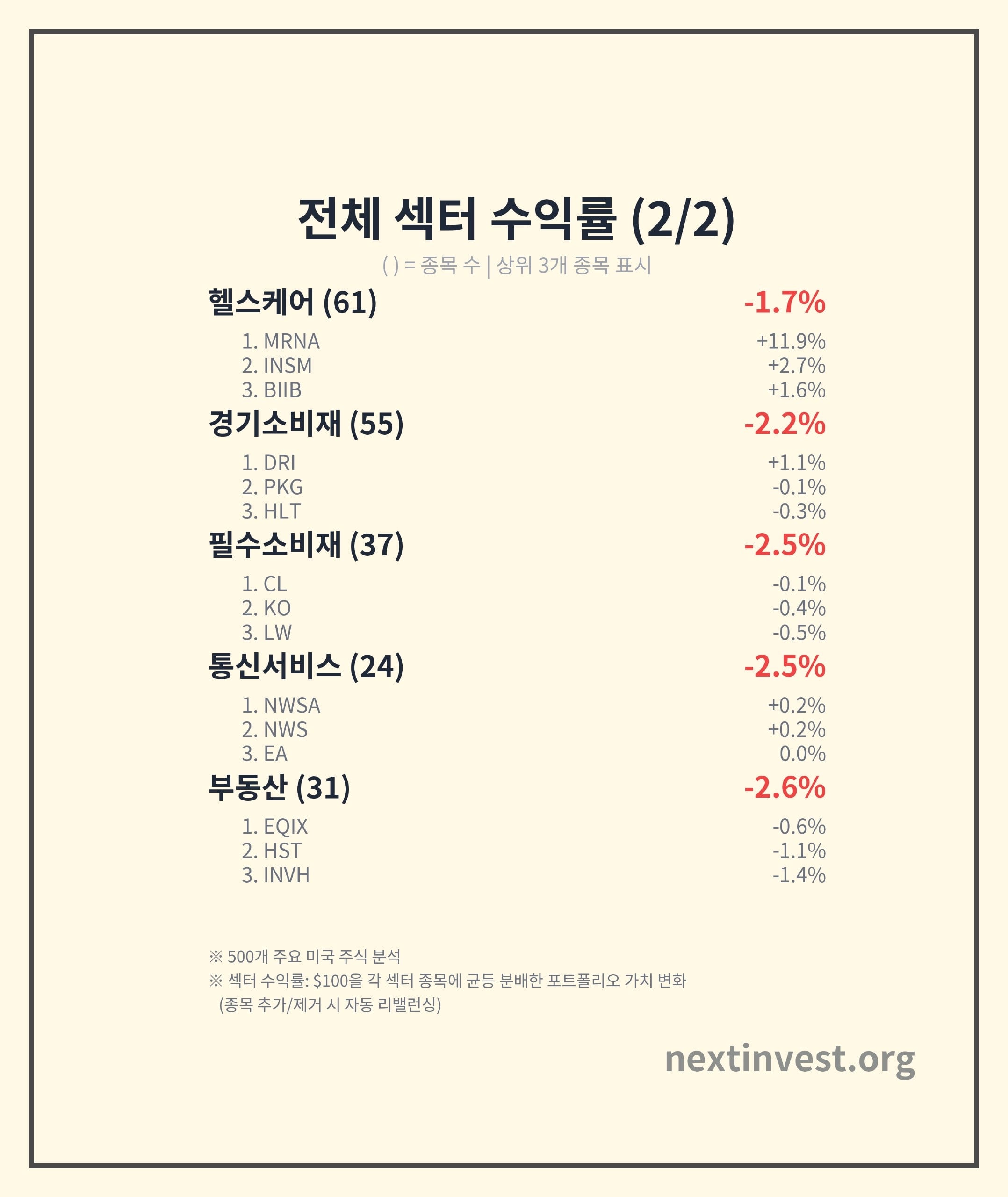
- Worst performing sector: Real Estate (-2.56%)
Looking at the 7-trading day trend, today's decline appears to be more than just a "random one-day adjustment" and suggests a possible direction change.
- Between June 11th and 16th, the technology, industrial goods, and consumer discretionary sectors rose for four consecutive days before plummeting today
- Even defensive consumer staples and utilities failed to act as safe havens, declining -2.47% and -1.42% respectively.
Below, we will look at the short-term (7-day) trend + medium-term (about 3 months) trend for major sectors to determine "whether this is just a breather or a signal of a trend reversal."
---
## 3. Tech Stocks: 3-Month Rally Halts After Fed's Single Word
Today's Performance:
- Sector 24H Return: -1.63% (Volatility 3.82%, 89 Stocks)
- However, some individual stocks remain strong: ARM +5.92%, WDC +5.18%, AMAT +4.71%
Short-Term (7-Day) Trend:
- 6/11: +2.15%
- 6/12: +1.04%
- 6/15: +2.06%
- 6/16: -1.73%
- 6/17: -1.63%
→ Three consecutive days of strong gains followed by two consecutive days of decline. Today's adjustment is a picture of the Fed "pouring cold water" on the overheated AI and semiconductor rally.
Medium-Term (About 60 Trading Days) Trend:
- Started at 100 on March 24th and reached 131.82 today, a gain of +31.82%
- A surge of +36% in the period from March 27th to May 28th, reaching 141.40 on June 2nd before
- 6/2~6/9: -7.9% adjustment, +1.22% recovery stage after 6/9
→ One-line summary: “Still in the midst of a strong rally, but getting breathless as it goes higher.”
Why did it move like this?
1. Interest rate sensitivity:
- Tech and growth stocks have a large portion of their stock price based on expectations for future earnings (future profits).
- When interest rates rise, the present value of these future earnings is discounted more heavily, putting pressure on stock prices.
- Today, even just the wording "possibility of a hike" caused valuations to be recalculated.
2. AI and semiconductor overheating:
- As various reports have repeatedly pointed out, AI, semiconductors, and high-growth software have led the market rally in recent months【(trading-revealed.com).
- When policy risks arise, like today, a psychology of "selling expensive stocks first" kicks in.
What does this mean for investors?
- The tech sector is still the biggest winner over the past three months.
- However, the adjustment from the early June high has been increasing, and today's Fed meeting could be the first signal of renewed volatility.
- For short-term investors, it can be interpreted as a timing to "realize some profits from AI/semiconductors and check the proportion of defensive stocks and cash,"
- For long-term investors, it can be seen as "the first opportunity opening up to buy quality tech stocks at discounted prices in installments."
---
## 4. Finance: Relatively Defensive Amid Interest Rate Uncertainty
Today's performance:
- Sector 24H return: -0.90% (smallest drop among 11)
- Representative gainers: Robinhood +8.57%, IBKR +2.14%, Morgan Stanley +1.69%
Short-term trend (6/11~6/17):
- 6/11: +0.75%
- 6/12: +1.22%
- 6/15: +0.13%
- 6/16: +1.06%
- 6/17: -0.90%
→ Adjustment level after four consecutive days of gains.
Mid-term trend:
- 3/24: 100 → today 110.93 (+10.93%)
- Slight decline and sideways movement from 4/24 to 6/3
- +6.05% clear upward trend since June 3rd
Why is it relatively resilient?
1. Interest rate ceiling maintenance/hike is positive for bank margins
- Because loan interest rates rise quickly and deposit interest rates rise slowly, net interest margin (NIM) can improve.
- Of course, loan demand may decrease due to economic slowdown, but NIM improvement expectations are reflected first in the short term.
2. Retail and trading platform rally (e.g., Robinhood)
- Recently, with the boom in options and short-term trading, the performance momentum of trading platforms has been highlighted【(investors.robinhood.com).
- Today, when volatility is increasing, increased trading volume → expectation of increased fee income acts as a positive factor for some financial sector stocks.
What does this mean for investors?
- As we enter the "interest rates may not fall further" zone, a gradual rotation from growth stocks to value and financial sectors may occur.
- Today, while all other sectors fell, finance showed relative strength, supporting this trend.
---
## 5. Real Estate: Direct Hit to Interest Rate Sensitive Sector
Today's performance:
- Sector 24H return: -2.56% (worst among 11)
- Representative Stocks: Equinix -0.56%, Host Hotels -1.12%, Invitation Homes -1.35%
Short-Term Trend:
- 6/11: -0.25%
- 6/12: +0.93%
- 6/15: -1.09%
- 6/16: -0.05%
- 6/17: -2.56%
→ The market experienced a significant downturn today, effectively marking a "selling day."
Mid-Term Trend:
- 3/24: 100 → Today 110.24 (+10.24%)
- 3/27~4/16: +8.7% increase, 4/16~6/3: additional +1.66% for a gradual upward trend
- 6/3~6/12: +4.45% acceleration, followed by a -3.65% decline after 6/12
→ The market saw a relatively solid rally until early June, but starting on 6/12, it appears that interest rate concerns began to be reflected.
Why is the Market Weak?
1. High Leverage (Debt) Vulnerability to Interest Rates:
- REITs (Real Estate Investment Trusts) and commercial real estate companies generally have high debt ratios and are very sensitive to financing costs.
- As the possibility of interest rate hikes increases, interest expense increases → dividend capacity decreases → valuation discounts follow.
2. Competition with Long-Term Bonds:
- Real estate and REITs are often considered "bond substitutes."
- If treasury bond yields start to rise again, the incentive to invest in REITs diminishes.
Implications for Investors:
- For investors who have entered the real estate market in the past three months, it is now crucial to scrutinize interest rates and debt structures more closely.
- Simply relying on "high dividend yields" as a reason for investment can be risky. During periods of rising interest rates, price declines could offset dividends.
---
## 6. Consumer Staples, Healthcare, and Utilities: No Safe Haven Today
Today's decline was not limited to "risk assets" but rather a near-universal market adjustment.
### 6-1. Healthcare
- Sector 24H Return: -1.72%
- Top Gainers: Moderna +11.95%, Insmed +2.71%, Biogen +1.56%
- Despite individual stock gains, the sector as a whole declined → Positive news for specific companies couldn't overcome the selling pressure at the index level.
Mid-Term Trend:
- 3/24 → Today +4.39% for a relatively small increase
- 6/2~6/9: Short-term +6% rally, followed by a -2.82% reversal from 6/9 to today
→ This can be seen as a correction after recent short-term overheating.
### 6-2. Consumer Goods (Essential and Discretionary)
- Cyclical Consumer Goods (Consumer Cyclical): -2.18% today
- Essential Consumer Goods (Consumer Defensive): -2.47% today
- Notably, essential consumer goods rose by over 5% from 6/3 to 6/15 but have since declined by -2.88%, reversing from a recent short-term peak.
→ Contrary to the common belief that "essentials are safe," even defensive stocks with high valuations were affected in today's market.
### 6-3. Utilities
- Sector 24H Return: -1.42%
- After a +3.24% recovery since 6/1, the sector reversed its trend today.
Implications for Investors:
- Following macro events like the Fed meeting, "cashing out" pressure can be stronger than sector rotation.
- Today served as a reminder that even traditionally defensive sectors like consumer goods and utilities are not immune to market corrections when valuations become excessive.
---
## 7. Energy: Oil Prices and Interest Rates, Double Pressure Continues Downward Trend
Today's Performance:
- Sector 24H Return: -1.23%
- Some stocks are holding up: EOG +0.91%, TRGP +0.41%, COP -0.12%
Short-Term Trend:
- 6/11: -1.77%
- 6/12: +1.01%
- 6/15: -3.25%
- 6/16: -0.72%
- 6/17: -1.23%
→ Downward trend has dominated for the past week.
Mid-Term Trend:
- 3/24: 100 → Today 90.60 (-9.40%)
- There were two strong rebounds in between (4/17~5/5, 5/7~5/18), but a -9.6% plunge after 5/18 has brought it back near the previous low.
Background Factors:
- Oil prices have fallen below $80 per barrel since June, showing weakness【(minotdailynews.com),
- This is lowering expectations for cash flow and CAPEX plans of energy companies.
- Meanwhile, interest rate uncertainty is raising concerns about demand reduction through economic slowdown, adding further pressure on oil prices.
What Does This Mean for Investors?
- Energy is already the only sector showing a clear downward trend over the past three months.
- For majors with strong dividends and cash flow (e.g., integrated oil & gas, midstream companies), consider gradually increasing their weight in your portfolio from a long-term perspective,
- However, be mindful of volatility in the short term as oil prices, interest rates, and the economy are all moving in the same downward direction.
---
## 8. Today's Keyword: “The Return of Interest Rates” – What Should We Look At Now?
Today's market can be summed up in one word: "The Return of Interest Rates".
While AI, individual stock stories, and M&A news drove the market from January to May, today saw "the Fed and interest rates" return as the main theme.
Here are some key points for investors to watch going forward:
1. Fed Officials' Statements:
- Today's dot plot alone increased uncertainty, but it's crucial to see how hawkish or dovish the tone of individual Fed officials' speeches will be.
2. Short and Long-Term Interest Rate Movements:
- If the 10-year Treasury yield rises rapidly again, today's sector pattern (growth stocks weakening, financials relatively strengthening, REITs weakening) could become a new mid-term trend.
3. Actual Inflation and Employment Data:
- The Fed may maintain a hawkish stance verbally, but if data deteriorates, it could suddenly change direction.
- In this case, today's adjustment could turn out to be a good buying opportunity.
---
## 9. What Does This Mean for Me? – Investment Strategy Summary
1) If you already have a large exposure to technology and AI:
- Today is a good time to review "why I am holding these stocks".
- It's important to select your portfolio based on performance, cash flow, and momentum, rather than simply assuming they will continue to rise.
2) If you have a low exposure to financials and value stocks:
- If interest rates remain "higher for longer" than expected, value stocks and financials with lower valuations could become relative winners again.
- Large banks, asset managers, and trading platforms are likely to benefit from the interest rate and volatility environment.
3) If you prefer dividend stocks and REITs:
- Today's simultaneous decline in real estate and utilities is a warning that "you shouldn't buy based on dividend yield alone".
- It's important to check the debt maturity structure of individual REITs, their hedging against interest rate risk, and the lease renewal cycle.
Finally, today's adjustment can be seen as the first moment when the market, which has risen sharply for three months, faced the "Fed reality" again.
- For long-term investors: "Increased volatility = opportunities to buy good assets at good prices" often occurs.
- For short-term traders: It is rational to focus on Fed statements, economic indicator announcements, and interest rate movements and adjust position sizes for the time being.
---
This report was written based on news released before 6:31 PM (Eastern Time) on June 17, 2026, and sector/portfolio data provided. The market environment can change rapidly depending on subsequent news releases or Fed statements.
This content is written for informational purposes only and does not constitute investment advice for specific securities or assets.
Source: https://nextinvest.org/ko
Free to share ^^