6/25 U.S. Stock Market — Industrials & Healthcare Lead, Large-Cap Tech Takes a Breather
June 25, 2026 Market Analysis
## 1. Today's Market at a Glance
June 25 was another day that illustrated the "rotation of money" in U.S. equity markets. With strong semiconductor earnings and still-elevated inflation signals colliding, the major indexes delivered mixed results, but sector-level flows clearly shifted toward industrials, healthcare, and energy.
- Index summary: The Dow rose approximately +1%, the S&P 500 edged slightly higher, and the Nasdaq closed down roughly -0.5%.(marketscreener.com)
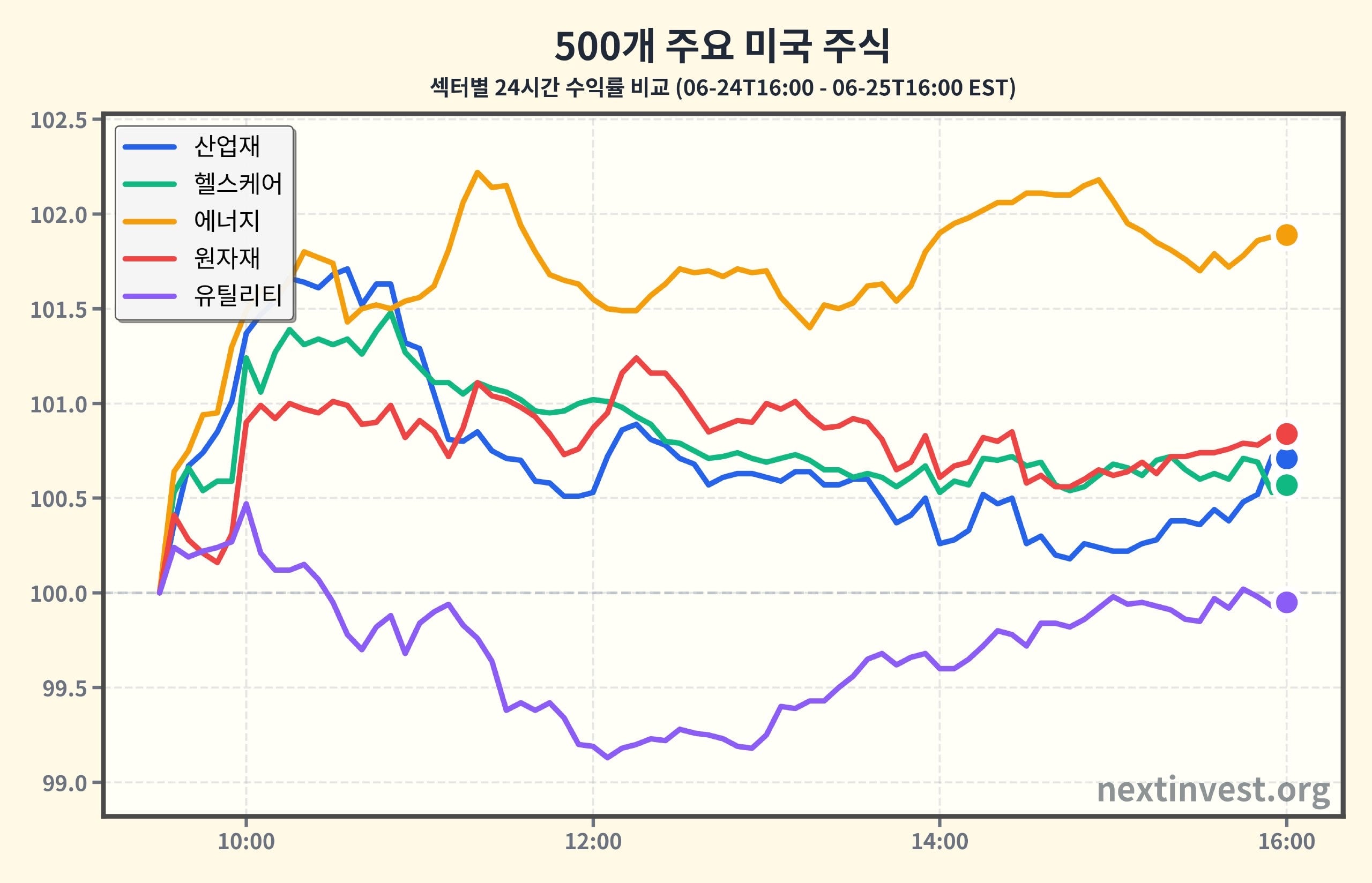
- Today's sector performance (based on your portfolio):
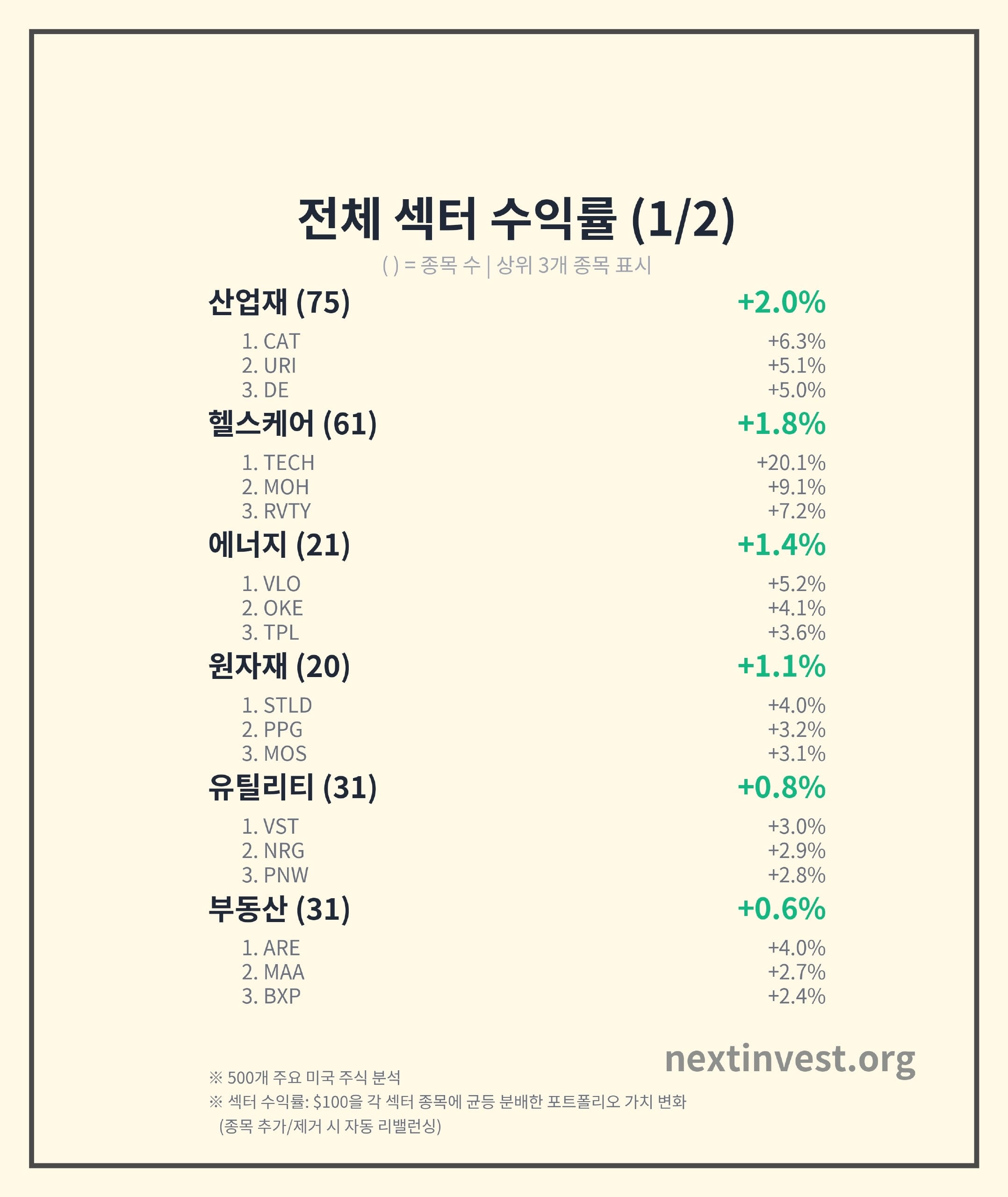
- Top gainers: Industrials (+1.98%), Healthcare (+1.79%), Energy (+1.39%), Basic Materials (+1.11%), Utilities (+0.84%), REITs (+0.58%), Consumer Staples (+0.02%)
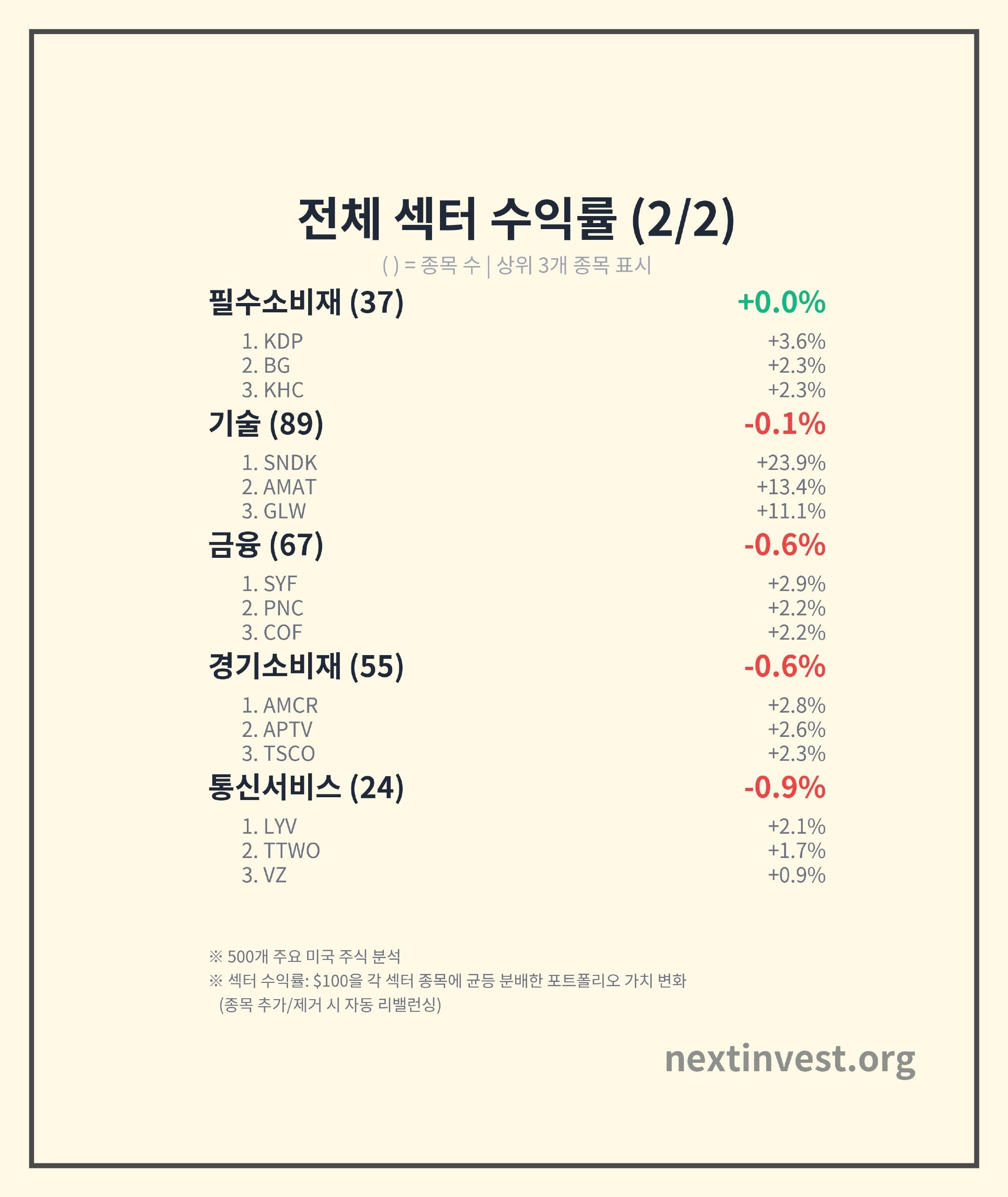
- Decliners: IT (-0.08%), Financials (-0.62%), Consumer Discretionary (-0.63%), Communication Services (-0.91%)
Key message:
The mega-cap tech and AI themes that have driven the market higher in recent months are pausing to catch their breath, while capital is visibly rotating into industrials, energy, and healthcare — sectors more closely tied to the real economy.
---
## 2. Tech Stocks: Semiconductors Surge, Big Tech Consolidates
### 2-1. What Happened Today
- Sector return (24H): Technology -0.08% (volatility 4.44%)
- Notable gainers:
- Sandisk (SNDK): +23.92%
- Applied Materials (AMAT): +13.42%
- Corning (GLW): +11.09%
Background news
- Micron's explosive earnings and guidance, reported the prior day, provided strong upward momentum through the early part of today's session.
- Analysis showed Q3 revenue of approximately $41.4 billion, adjusted EPS of roughly $25, and revenue more than tripling year-over-year, with next-quarter revenue guidance of around $50 billion — confirming that AI memory demand remains explosive.(m.ajupress.com)
- In the wake of these results, not only Micron but also SNDK, Western Digital, and other memory and storage-related stocks surged sharply even before the open.(m.ajupress.com)
- On a global level, the strong semiconductor earnings were also assessed as a catalyst lifting equity markets worldwide.(marketscreener.com)
Despite all this, the sector as a whole finished down -0.08%. Memory and equipment stocks rallied, but profit-taking in the mega-cap platform, cloud, and software names that had run up the most weighed on the overall index. Reuters and other outlets interpret this as a "rebalancing driven by valuation pressure."(investing.com)
### 2-2. Viewing This Within the Short- and Medium-Term Trend
- 7-day trend:
- 6/18 +1.50% → 6/22 +0.27% → 6/23 -2.96% → 6/24 +0.43% → 6/25 -0.08%
→ After a brief recovery early in the week, a sharp pullback on the 23rd was followed by a mild plus, near-flat, then slightly negative close — a pattern suggesting fading momentum.
- Medium-term trend (portfolio analysis):
- From a base of 100 on 3/31, the sector now stands at 134.39 — up approximately +34%, still the dominant outperformer over this period.
- After a strong rally from mid-May (5/19–6/4: +14.9%), the sector has gained only about +1.6% since June 5, indicating a significant deceleration in pace.
### 2-3. What This Means for Investors
- If you already carry a large allocation to AI, semiconductors, and big tech:
- A session like today — where earnings are strong yet stocks fail to lift the broader market — can be a signal that the market says "we believe the growth story, but the price is too high."
- Keep in mind the potential for increased short-term volatility and range-bound trading, and scrutinize individual company earnings and valuations more carefully.
- If your IT exposure is still low:
- This consolidation could represent a "dollar-cost averaging opportunity during the breather" for long-term investors. That said, rather than a broad sector ETF, it is more advantageous for risk management to focus selectively on semiconductor, equipment, and specific infrastructure companies where cash flow and earnings are actually growing rapidly.
---
## 3. Industrials & Healthcare: Today's Real Stars
### 3-1. Industrials: Money Moves into Cyclicals
- Today's performance: +1.98% (volatility 2.50%). Of the past 7 trading days, the sector gained on four — 6/18, 6/22, 6/24, and 6/25 — making the upward trend this week quite clear.
- Notable stocks:
- Caterpillar (CAT): +6.29%
- United Rentals (URI): +5.15%
- Deere (DE): +5.00%
All of these companies are directly linked to real-economy investment and global cyclical recovery — construction, heavy equipment, infrastructure, and agricultural machinery. Multiple market commentaries explain that some capital is rotating out of recently corrected tech stocks into cyclical names with stable medium-to-long-term growth stories.(finlore.io)
- Medium-term trend:
- The industrials sector portfolio is up +11.9% since 3/31.
- After a steady, gradual uptrend since 5/18, the sector has added nearly +3% over just the past two days (6/24–25), with recent momentum clearly strengthening.
What does this suggest?
> It is a signal that the market is saying "AI alone is not enough to build a portfolio" and is diversifying risk into sectors tied to the real economy and infrastructure.
- From a long-term investment perspective, gradually increasing exposure to industrials/infrastructure-related ETFs or high-quality individual stocks can help reduce overall portfolio volatility.
### 3-2. Healthcare: Spotlight on a Major M&A Deal
- Today's performance: +1.79% (volatility 2.58%)
- Notable surge:
- Bio‑Techne (TECH): +20.07%
The catalyst was a major acquisition announcement.
- Germany's Merck KGaA agreed to acquire U.S. biotech and diagnostics company Bio‑Techne for approximately $11.3 billion.(fiercepharma.com)
- The offer price represents a premium of approximately 36% over the average share price of the past month, illustrating how strategically the market values this company.(fiercepharma.com)
- Bio‑Techne has served as an "essential component supplier" to the research and biopharmaceutical industry — providing cell therapy products, antibodies, and diagnostic reagents.(cbsnews.com)
The healthcare sector gained only +9% over the past 60 trading days, but has risen +4.9% in just the current window since 6/22, with short-term momentum rapidly reviving.
What this means for investors
- It suggests that the environment where investors are willing to pay high valuations for companies with proven growth stories — as seen in big tech and semiconductors — is now expanding into healthcare and life sciences.
- Healthcare, which has a relatively low correlation with the economic cycle,
- can offer both portfolio defense (defensive) and growth optionality simultaneously,
- and a large M&A deal like today's can raise the prospect of revaluation for similar mid-cap biotech and diagnostics companies ("could they be the next acquisition target?").
---
## 4. Energy, Basic Materials & Utilities: A Window Into Inflation and Rate Expectations
### 4-1. Energy: A Single-Day Bounce Within a Downtrend
- Today's performance: +1.39%
- VLO +5.21%, OKE +4.14%, TPL +3.57% — refiners, pipelines, and energy royalty names led the gains.
- However, the cumulative return since 3/31 stands at -8.75%, the worst among all 11 sectors.
- Looking only at the period since 5/18, the sector is down -8.8% in an ongoing downtrend — today's bounce is just that, a single-day rebound within that trend.
International oil prices and commodity prices have been weak amid a mix of growth slowdown concerns and supply factors, and some reports interpret this as "a signal that inflationary pressure is gradually easing."(finlore.io)
Implications:
- Energy stocks can be attractive for dividends and cash flow, but the sector swings sharply on oil prices, policy, and geopolitical risk.
- Today's action looks more like short covering and a technical bounce — it is too early to call an end to the medium-term downtrend.
### 4-2. Basic Materials & Utilities: Capturing Real Demand and Rate Sensitivity Simultaneously
- Basic Materials: +1.11% today; names like STLD, PPG, and MOS — steel, coatings, and fertilizers — are structurally tied to industrial demand and agricultural/infrastructure investment.
- Over the past 60 days, however, the gain is a modest +1.6%, and the sector has been in a -1.2% downtrend since 5/27.
- Utilities: +0.84% today; the sector has quietly gained +7.5% since 6/1, maintaining a steady under-the-radar bull run.
From an interest rate perspective:
- The 10-year U.S. Treasury yield edged slightly lower today to around 4.38%, as the market simultaneously prices in the possibility of slowing growth and an extended period of elevated rates.(finlore.io)
- The fact that rate-sensitive utilities and REITs (real estate) have been quietly strengthening over the past few weeks can be read as:
- the market expectation that "growth will be maintained, but aggressively hiking rates further as in the past is too much of a burden" is gradually being priced in.
---
## 5. Financials, Consumer & Communication Services: Sectors Quietly Falling Behind
### 5-1. Financials: A Tug-of-War Between Rates and the Economy
- Today's performance: -0.62%
- Even so, select individual names such as SYF, PNC, and COF — some bank and card stocks — posted gains of around 2%.
- The 60-day cumulative return of +8.7% is respectable, but since 6/16 the sector has shifted into a -1.9% declining trend.
Market participants report that because key inflation indicators such as core PCE are still coming in elevated,
- the view that "it is difficult to expect large rate cuts anytime soon" and
- the view that "further tightening to cool the economy further is too burdensome" are coexisting.(reddit.com)
In this ambiguous environment, the financial sector is becoming a "neutral" sector that finds it difficult to move strongly in either direction.
### 5-2. Consumer Sectors: Staples Steady, Discretionary on a Rollercoaster
- Consumer Staples: essentially flat at +0.02% today.
- Food and beverage names such as KDP, BG, and KHC posted gains of 2–3%, once again demonstrating the stability of consumption that is independent of the economic cycle.
- Consumer Discretionary: -0.63% today, essentially a pullback from the sharp +2.21% surge the prior day (6/24).
Looking at the 7-day trend, Consumer Discretionary moved +1.33% → -1.29% → -0.24% → +2.21% → -0.63% — up one day, down the next, behaving like a "sector with extreme mood swings."
> A polarized consumer environment — where financially robust households and financially stressed households coexist simultaneously — is being reflected directly in stock prices.
### 5-3. Communication Services: Correction in Advertising, Entertainment & Platforms
- Today's performance: -0.91% (volatility 2.51%)
- The 60-day return is also -3.5%, and the sector is down -9.5% in just the period since 6/1 — a clear downtrend.
This sector is a mix of large platforms, telecoms, media, entertainment, and gaming, facing a combination of:
- valuation pressure across tech and growth stocks broadly,
- concerns about a slowdown in the advertising cycle, and
- intensifying competition in subscriptions and content.
For investors, the need to distinguish between companies where the growth story remains valid and those where near-term earnings are decelerating has grown substantially in this phase.
---
## 6. Summing Up Today From a Portfolio Perspective
### 6-1. The Big Picture: Not 'Abandoning AI,' But 'Not Relying on AI Alone'
Synthesizing today's news and numbers, the market can be interpreted as acknowledging the long-term growth potential of AI and semiconductors while correcting the portions of the market that have risen too far, too fast.(investing.com)
- Short-term (7-day) basis:
- Industrials, healthcare, utilities, and REITs are quietly trending upward,
- while IT, communication services, and financials show weak directionality or are tilting lower.
- Medium-term (60-day) basis:
- IT remains the sector with the largest cumulative gain (+34%), but the pace of the rally has slowed.
- Industrials, healthcare, and utilities are showing a gradual but steady upward trend, serving as the "pillars" of the portfolio.
### 6-2. Practical Implications for Investors
1. The case for sector diversification strengthens
- On days like today — when "earnings are good but the indexes are mixed" — sector composition, more than individual themes or stocks, determines returns.
- If you already carry a heavy weight in IT and communication services, now may be the right time to consider diversifying a portion into industrials, healthcare, utilities, and consumer staples.
2. M&A and earnings create 'hidden winners'
- Mid-cap companies that play a critical infrastructure or platform role — like Bio‑Techne — are natural acquisition targets for large corporations.
- Rather than simply saying "it's biotech, so it's risky," the perspective of asking whether a company provides essential equipment, materials, or services to an industry is becoming increasingly important.
3. Rates and inflation: 'High, but too burdensome to raise further'
- Even as inflation indicators are cited as still elevated, the market is pricing in the prospect of rates staying higher for longer.(reddit.com)
- In this environment, utilities, REITs, select energy names, and consumer staples — with stable dividends and cash flows — serve as a buffer to balance out aggressive growth stocks.
---
## 7. Closing: Points to Watch as We Prepare for Tomorrow
1. The 'second-order beneficiaries' of the AI and semiconductor rally
- The strong results and surges in Micron, SNDK, AMAT, and others ripple through the entire upstream and downstream ecosystem for storing, transmitting, and processing data — materials, equipment, and infrastructure.
- Rather than chasing short-term spikes, a better approach is to ask: "If this demand persists for 3–5 years, which companies will earn money most reliably?"
2. Confirming the 'sustainability' of industrials, healthcare, and utilities
- Whether the three sectors that led today's gains maintain their relative strength this week and next
- could be a clue for judging whether the market has truly begun a structural rotation from "big tech → real economy and defensives."
3. Upcoming inflation and employment data
- Forthcoming indicators such as PCE inflation — the Fed's most closely watched measure —
- will help gauge which way the weight tilts: "prolonged high rates vs. a gradual easing."
- This will have a direct impact on bank valuations, REITs, and growth stock valuations alike.
Today was a day when industrials, healthcare, energy, and utilities quietly elevated their standing while mega-cap tech paused to catch its breath.
For long-term investors, it is a day worth remembering as one that confirmed the signal: "This is no longer a market that belongs to AI alone."
This content has been prepared for informational purposes only and does not constitute a recommendation to invest in any specific stock or asset.
Source: https://nextinvest.org/ko
Feel free to share without permission ^^