After riding today, I'll write a review.
Screen Visibility
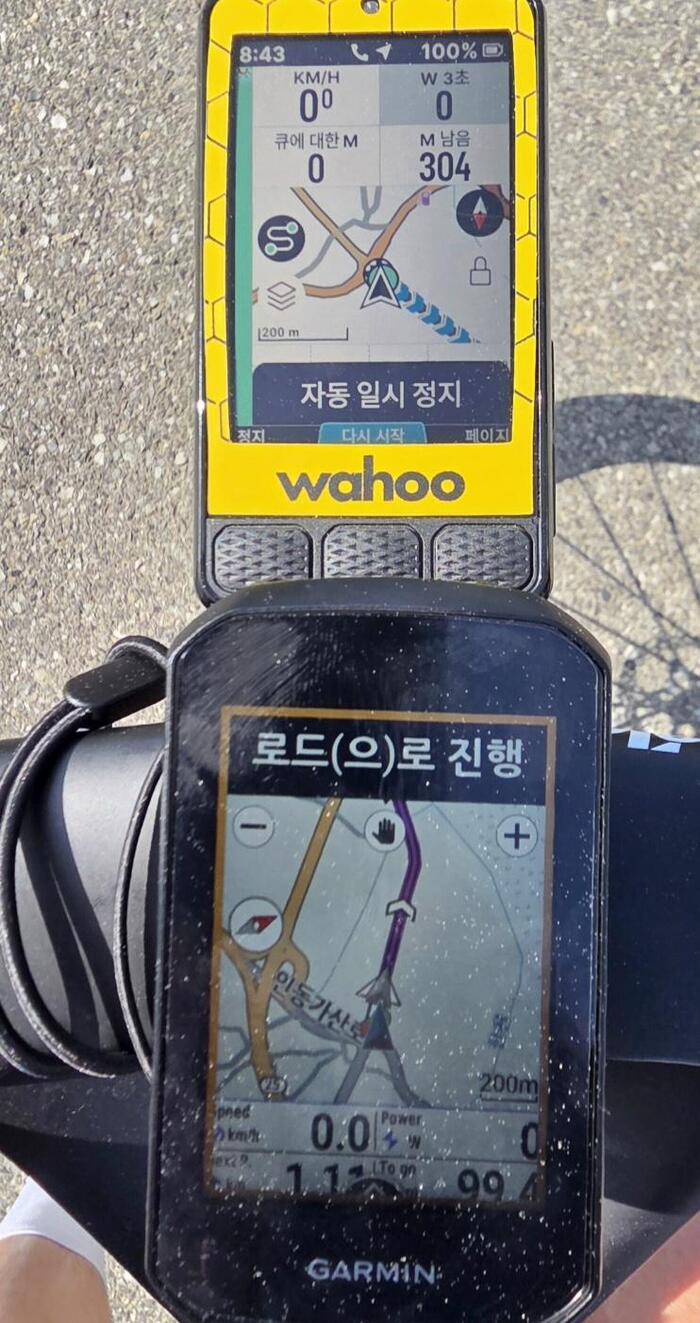
In bright daylight, the ROM3 is easier to see than the Garmin 850.
The ROM3 has a screen like a Casio digital watch, so even with the backlight off in bright environments, it's incredibly visible.
In contrast, the Garmin 850 works like a smartphone, so you need to set the backlight to maximum brightness to see it clearly in direct sunlight.
When both devices had auto-brightness settings, the ROM3 was noticeably easier to see than the Garmin 850 under direct sunlight.
The coating or material of the LCD screen on the ROM3 seems to be matte and less prone to fingerprints. It also has less glare.
The Garmin 850 had an Oleophobic film applied, but I'm not sure why it had some glare.
However, when I entered a shaded area under trees, the Garmin was easier to see.
Although there wasn't a huge difference.
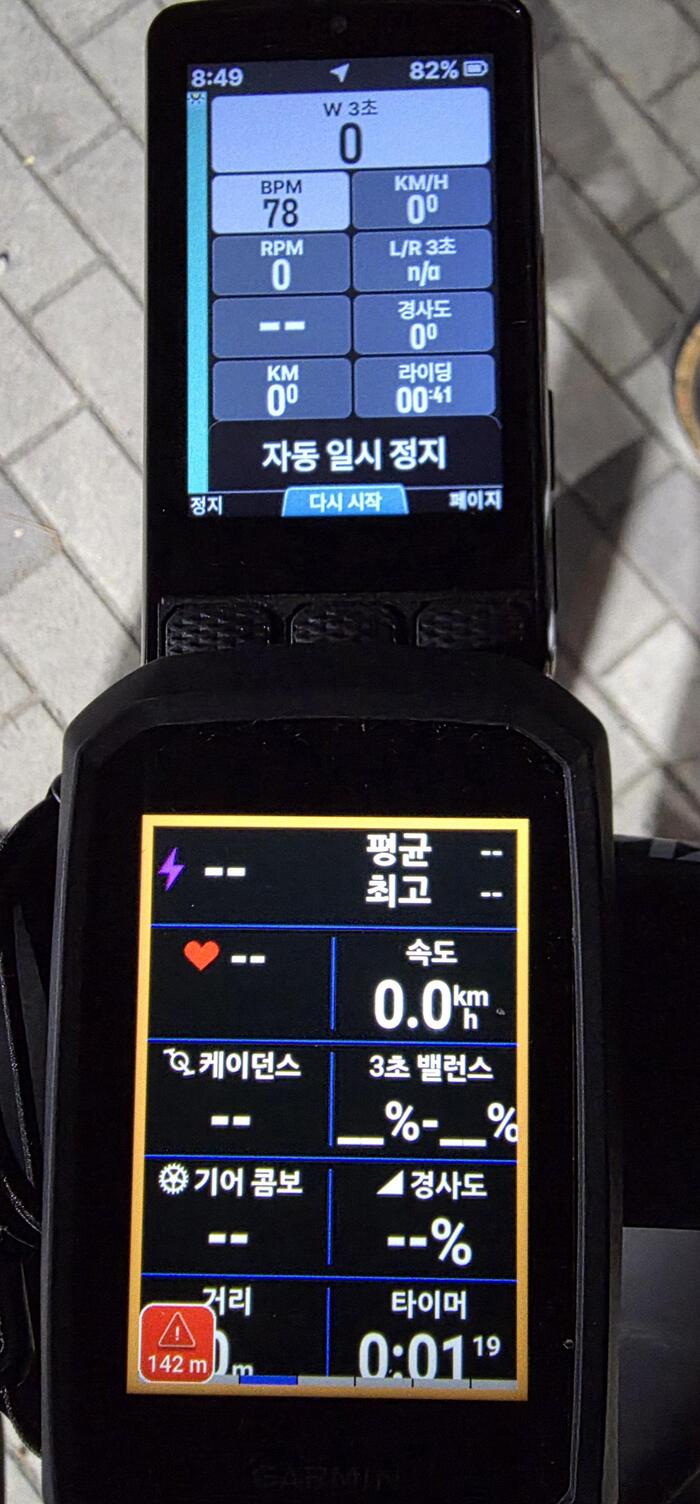
At night, both devices were easy to see, but the Garmin's higher screen resolution made it stand out more.
The ROM3 had a slightly hazy appearance at night as if a filter was applied.
Hill Climbing
The Garmin is more accurate than the Wahoo for hill climbing.
Currently, both devices have climb settings set to "unclassified," meaning all climbs are displayed as climbs.
However, the Garmin detects even slight inclines as uphill climbs, while the Wahoo doesn't recognize some inclines as climbs.
When starting a climb, the Garmin starts recording from where it recognizes the uphill section begins and ends when it senses the climb is finished.
In contrast, the Wahoo starts recording the climb much later after recognizing it and ends even though there's still an uphill section ahead.
Subjectively, the Garmin accurately recognized uphill climbs.
Another significant difference:
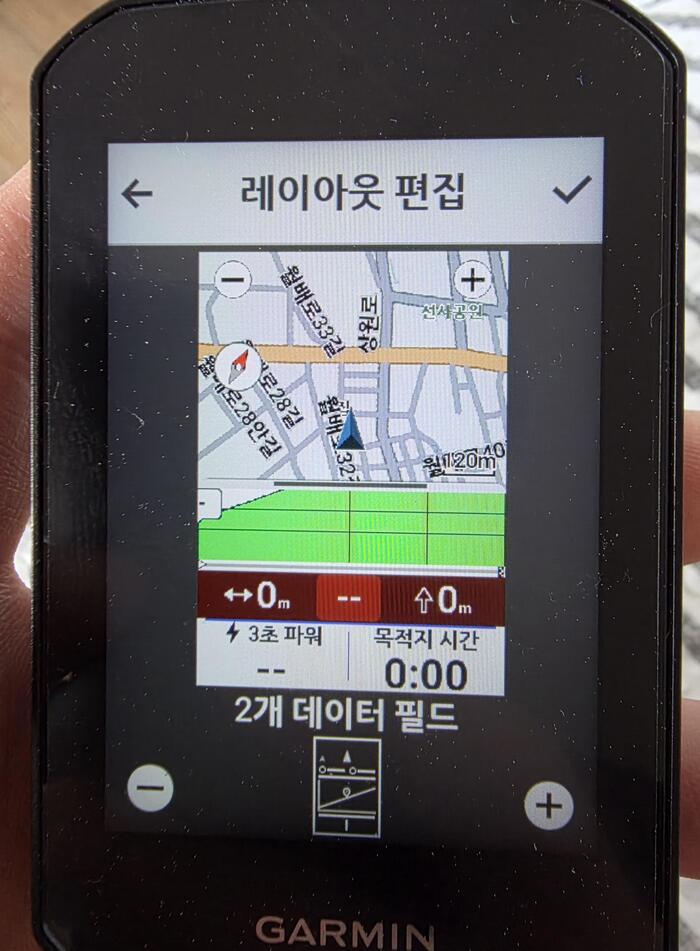
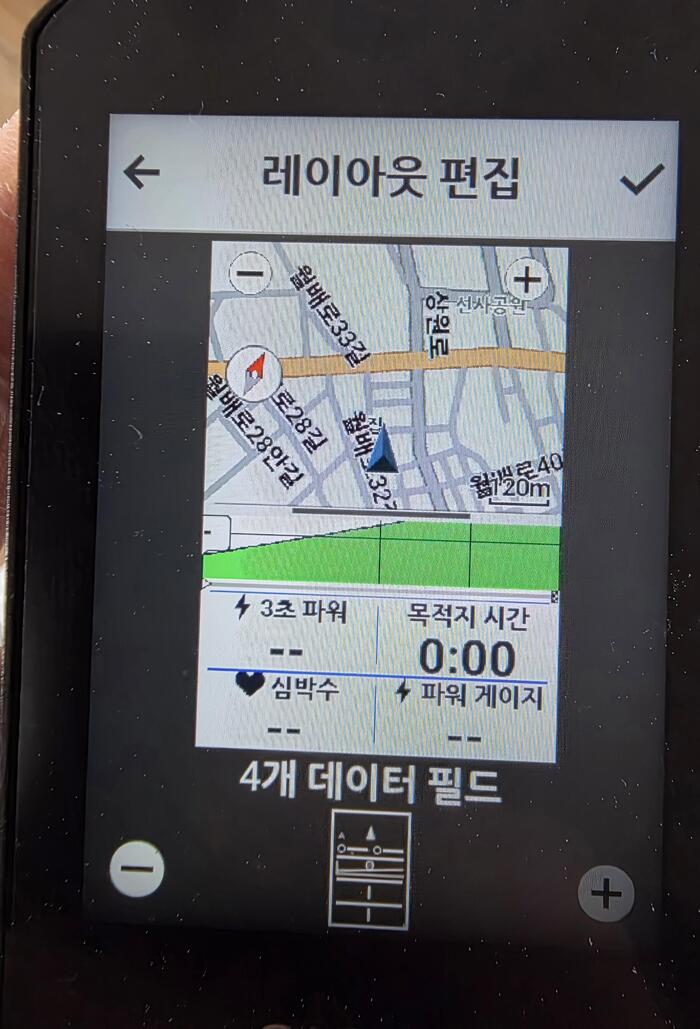
During climbs, the Garmin displays a map along with the gradient, while the Wahoo only shows the gradient.
Because the Garmin displays both a map and gradient, you can only set up two to four data fields.
When using four fields, information about remaining climb distance and elevation gain is unavailable.
Previously, I could set one field and use Garmin Connect to expand the information fields.
However, setting one field is no longer possible, making usability questionable.
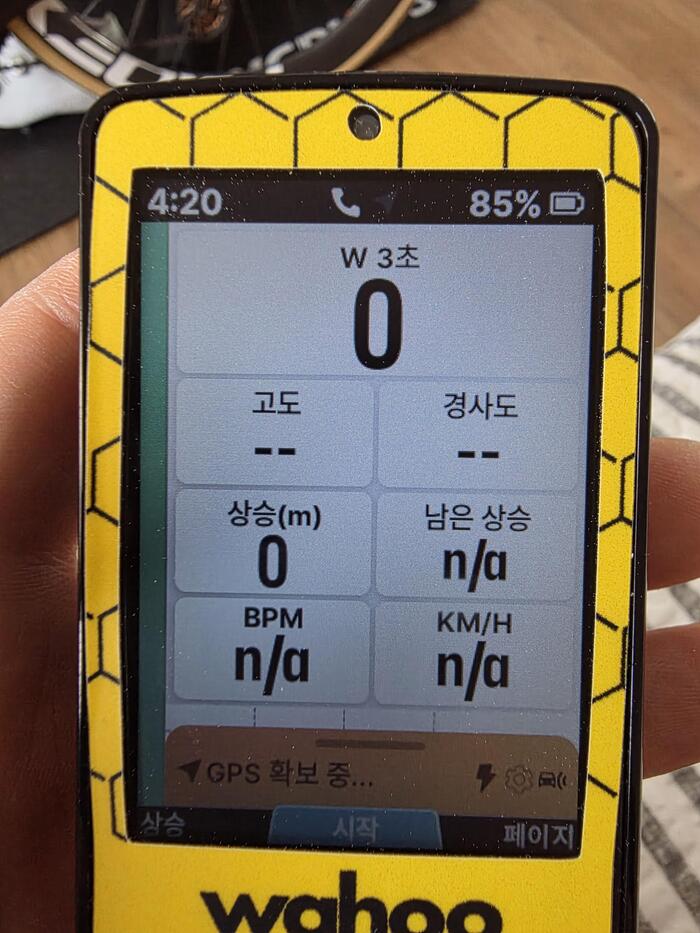
The Wahoo doesn't display a map but shows only the gradient.
Instead, one field is fixed, and you can customize six fields.
Specifically, even with six fields set up, you can use zoom in/out buttons to reduce the number of data fields and enlarge the size of each field for better visibility.
Maps and Navigation
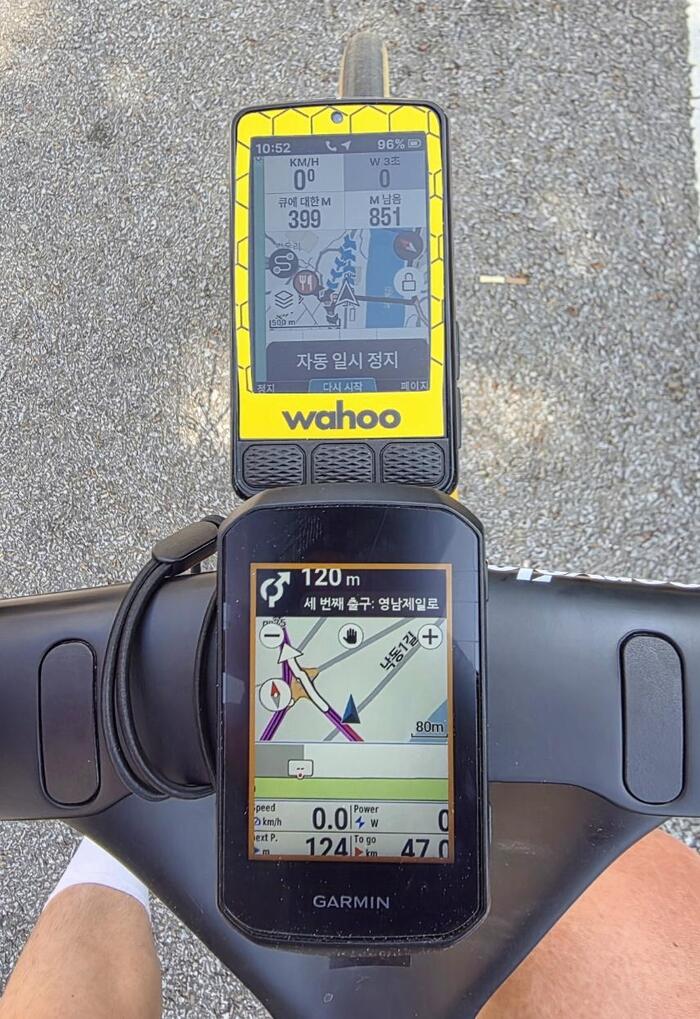
The Wahoo has better map detail.
However, when it comes to route guidance, the Wahoo's directional arrows are too frequent and large, making them slightly inconvenient to view.
While the Garmin's map detail is slightly less precise, it accurately distinguishes the intended route with color coding and presents it in a simple, easy-to-understand manner.
However, due to the difference in detail, smaller side roads were easier to see on the Wahoo.
Previously, I mentioned that the Garmin uses pop-ups to alert you at forks in the road, while the Wahoo doesn't have this feature.
However, the Wahoo also uses pop-ups for navigation.
Unlike the Garmin, which alerts you even for slight turns, the Wahoo only seems to notify you at major junctions where confusion might arise.
If you are following a new route map, I think the Garmin would be easier to follow.
Battery Life
The Wahoo wins hands down in terms of battery life.
Both devices had auto-brightness settings enabled.
The Garmin was connected only to sensors for GPS speed tracking, while the Wahoo was connected to speed, heart rate, power meter, rear radar, and Di2.
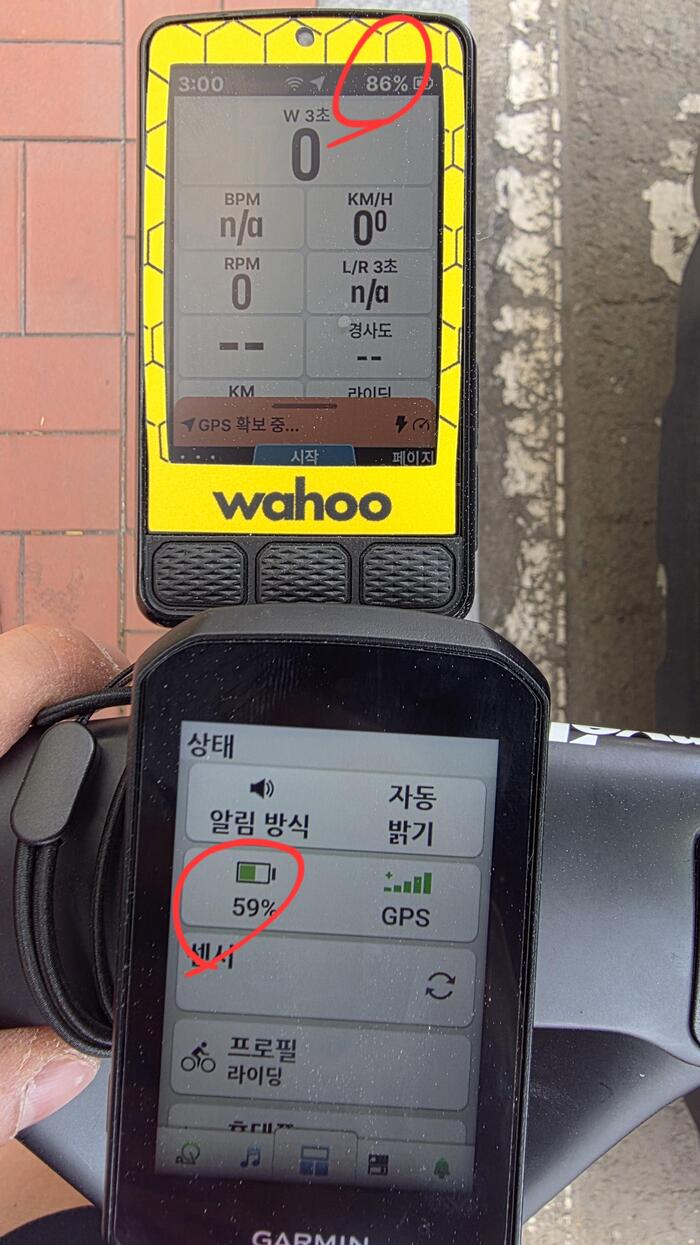
During a 4 hour and 30 minute ride in daylight, the Wahoo (ROM3) battery dropped from 100% to 86%, while the Garmin 850 battery dropped from 100% to 59%.
The backlight on the Garmin is always on during the day, while the backlight on the Wahoo is off. This difference in backlight usage likely explains the battery life discrepancy.
I haven't directly compared battery life at night, but even with the backlight constantly on, the Wahoo didn't consume significantly more battery than the Garmin.
Since I typically ride longer distances during the day and shorter rides (2-3 hours) at night, the Wahoo's battery life would be a significant advantage for me.
Other Features
The Garmin has more additional features.
The Garmin emits a beep when you shift gears to indicate that it's in a different gear.
It also allows you to set heart rate alerts and customize Di2 buttons.
On the Wahoo, Di2 button customization is limited to rightward page changes, while the Garmin allows for both left and right button customization.
After considering all these factors, I think the Wahoo is a better choice for me.
However, if I sell my Garmin, I'll probably miss it.
And vice versa – if I sell the Wahoo and use the Garmin, I'll likely miss the Wahoo too…
Even after writing this, I still haven't overcome my decision paralysis!