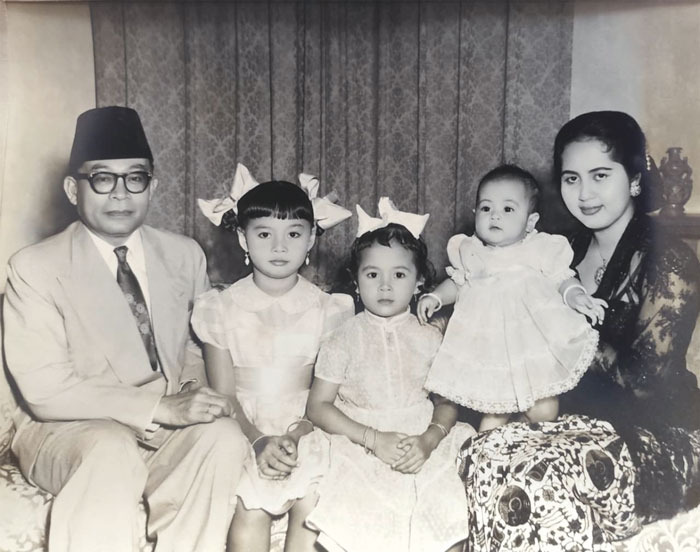
 Mohammad Hatta with his family: (from left) Mohammad Hatta, Meutia Farida Hatta,
Gemala Rabi’ah Hatta, Halida Nuriah Hatta, and his wife, Siti Rahmiati Hatta. Photo courtesy of Mohammad Hatta’s Family.
In honour of Indonesia’s Independence Day, NOW! Jakarta sits down with the former Vice President’s daughter, Halida Nuriah Hatta, to reflect on her father’s legacy.
Alongside President Sukarno, Mohammad Hatta —affectionately known as Bung Hatta—played a pivotal role in the country’s struggle for independence. As its first vice-president, he championed diplomacy, economic development, and non-violent political action. His contributions helped steer Indonesia towards sovereignty and progress, while his ideas on democracy, cooperatives, and social justice continue to inspire generations of Indonesians.
As Indonesia commemorates its 81st Independence Day, Hatta’s leadership, integrity, and dedication remain as relevant as ever. In the reflections of his youngest daughter, Halida Nuriah Hatta, we revisit the values and principles that shaped one of the nation’s founding fathers.
Like her elder sisters, Meutia Farida Hatta and Gemala Rabi’ah Hatta, Halida has dedicated herself to preserving and promoting her father’s legacy. Through lectures, seminars, and public discussions, they continue to share Bung Hatta’s principles of leadership, which they believe remain essential for today’s decision-makers, public officials, and citizens alike to safeguard Indonesia’s independence and strengthen a nation built on integrity.
Born on 25 January 1956, Halida was less than a year old when Bung Hatta resigned as vice-president on 1 December that same year. Although she was too young to have witnessed them first-hand, she grew up learning about his remarkable contributions to his newly independent country. One of the achievements she recalls most vividly was his role in leading a delegation at the Konferensi Meja Bundar (Round Table Conference) in The Hague in 1949, where he helped secure international recognition of Indonesia’s sovereignty.
Those negotiations, following the Linggadjati, Renville, and Roem–Roijen agreements, ultimately led to the transfer of sovereignty to the Republic of Indonesia. Beyond the international stage, Bung Hatta also engaged in dialogue with regional political leaders and kingdoms throughout the archipelago, building consensus and trust to unite them into a single nation.
“I always remember Bung Hatta saying that diplomacy is about negotiation, consultation, and achieving results step by step. It requires skill and understanding. We must know the other party as well as our own interests. Before negotiating, we must put our own house in order, because that is what is reflected abroad. Above all, the nation must uphold its dignity,” Halida recalled.
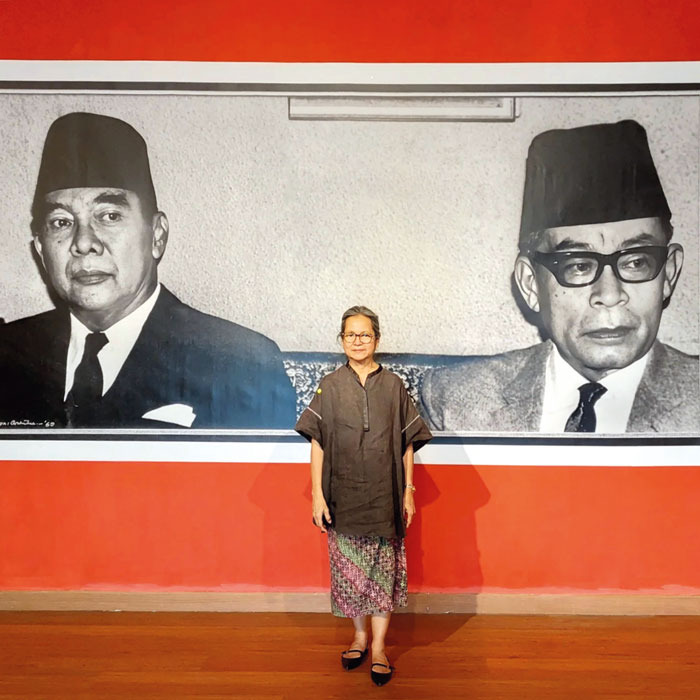 Halida Nuriah Hatta. Photo courtesy of Mohammad Hatta’s Family.
Bung Hatta, she added, possessed a rare ability to adapt to different situations without compromising his principles. As a statesman, he understood the importance of integrity and the image he projected to the international community, recognising that every action reflected Indonesia’s struggle and aspirations. Yet when he was among ordinary people, he spoke with humility and warmth, engaging with them as an equal.
Honesty, discipline, and personal responsibility were values he practised consistently throughout his life. Halida also remembers her father’s frequent reminder that holding an important position carries a greater obligation to set an example for others.
“Maintaining a good reputation is not easy. Like my mother always said: noblesse oblige [nobility obligates]. Being a role model means demonstrating good conduct and exercising self-control. That was how Bung Hatta lived. He honoured his commitments. He was disciplined without being authoritarian. He believed in process, but he also believed in making every effort to achieve results. He remained true to his principles, and to uphold those principles, one must have a clear plan.”
Halida observed that the Reformasi era brought greater political openness, but also led to the emergence of multiple centres of power and competing interests. In her view, the absence of adequate checks and balances allowed vested interests to exert increasing influence over policymaking. She argued that some lawmakers prioritised personal and business interests over their responsibility to represent the people.
Reflecting on her father’s views, Halida emphasised that Bung Hatta regarded government as fundamentally a matter of good governance and institution-building.
“Government, as Bung Hatta often said, is about governance. What kind of system do we want to build? If what we see and face today is still marked by shortcomings and mistakes, then we must have the courage to address and correct them,” she said.
More than seven decades after Indonesia achieved independence, Bung Hatta’s legacy continues to resonate. His commitment to diplomacy, integrity, and principled leadership offers enduring lessons for a nation facing new challenges in a rapidly changing world.
For Halida, these values remain at the heart of her father’s contribution to Indonesia—proof that true leadership is measured not only by achievements, but also by character.

