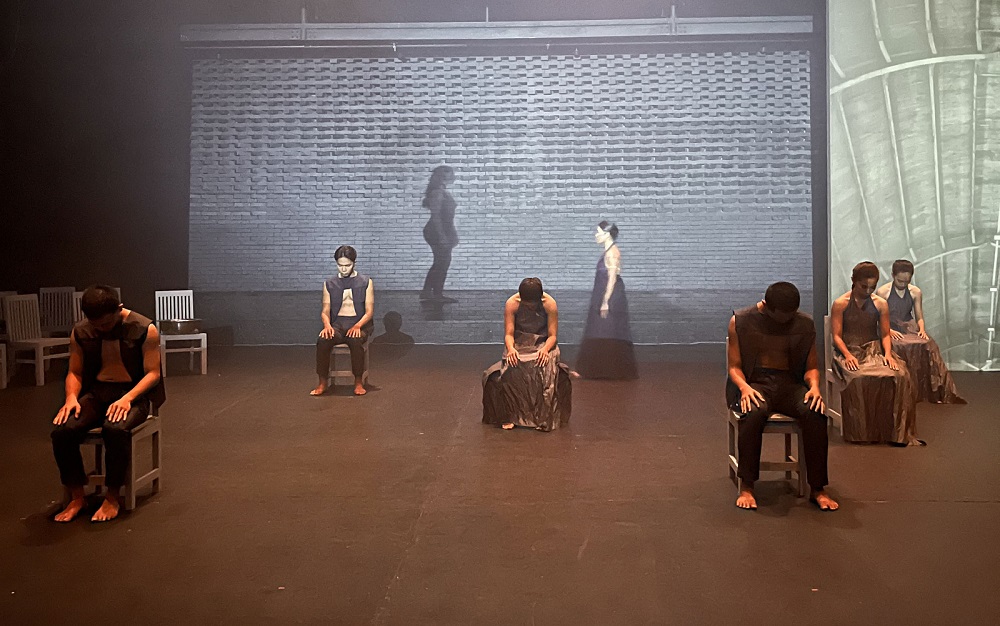
Sit dancers sit on plain grey chairs, they’re barefoot and folded forward, hands heavy on their thighs. Behind them, a filmed figure walks along a brick wall while a woman in a long dark-grey dress crosses the stage. Nothing is dramatic about it, and maybe that is part of the beauty of the show, it draws you in without demanding for attention. The bodies move with the drag and suspension of figures underwater – or somewhere closer to the underworld – already inhabiting a place where ordinary time no longer seems to apply.
That tension runs through Melati Suryodarmo’s Orfeus, presented at the Black Box Salihara as part of SIPFest 2026. The 60-minute dance-theatre work is based on Goenawan Mohamad’s poem “Orfeus”, written in 2006 and later included in his collection Tigris. It takes the familiar myth of Orpheus and Eurydice and strips away much of its heroic romance. What remains is something less flattering and probably more recognisable. Our tendency to keep returning to what had already gone.
Goenawan’s poem relocates the Greek myth to a small railway station. Five minutes before the train leaves, Eurydice tells Orpheus, “I will not return.” A platform, clock, signal, benches and railway tracks replace the entrance to the underworld. This change of location might make one wonder whether it was simply the easier choice, a more familiar way to portray departure in this modern interpretation.
However, during the post-performance discussion, Goenawan explained that the train, the station, and clock were images of mortality and the impossibility of returning through time. People arrive, wait and leave at a station, and sometimes the person left behind can do little except watch the distance grow. Melati then takes those images and asks why they might look like once they enter the body.
The dancers move at a pace that seems to belong to another physical environment, their limbs meet resistance that the audience cannot see, it really does seem as though they are travelling through water or the dense air of the underworld. The slowness never feels empty, it sharpens every adjustment of the spine, every hand that lifts and every foot placed against the floor. You begin to watch differently, noticing things that would normally pass unseen, even the fall of a dance’s braid. Rather than building momentum in the usual theatrical sense, the choreography holds the dancers inside a continuous state of descent. This is where the underworld really begins to seep it.
Melati spoke after the performance about the influence of Butoh, a Japanese avant-garde dance-theatre form associated with slow, highly controlled movement, and Bedhaya, a ceremonial Javanese court dance characterised by measured movement and solemn atmosphere. “In Butoh, slow movement is connected to the soul moving, or living, within memories absorbed by our muscles.”
That sense of memory living in the muscles is carried directly into the choreography. Instead of depicting the underworld through flames, caverns or a clear border between life and death, Orfeus places it within the dancers’ bodies. Their movements are weighted and suspended, as though they are travelling underwater or through a past that keeps resisting every attempt to leave it.
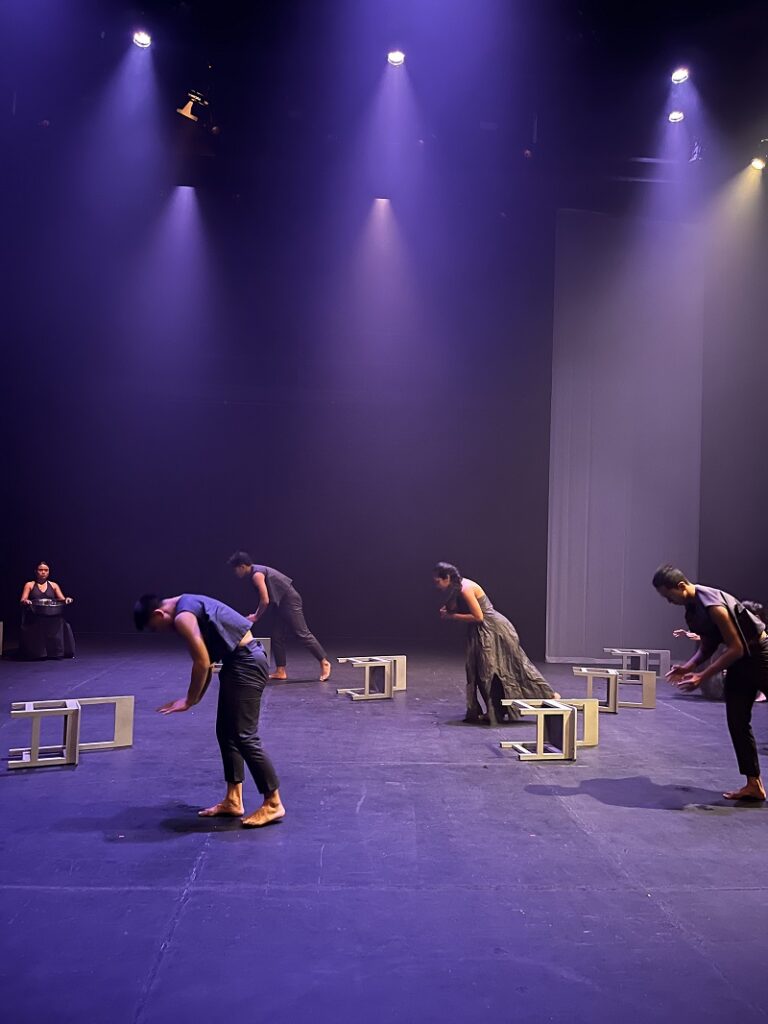
The chairs initially resemble station seating, as the performance progresses, they are moved, overturned and piled unevenly at the side. The orderly station gradually becomes a fractured mental space, somewhere Orpheus can neither return to nor fully escape.
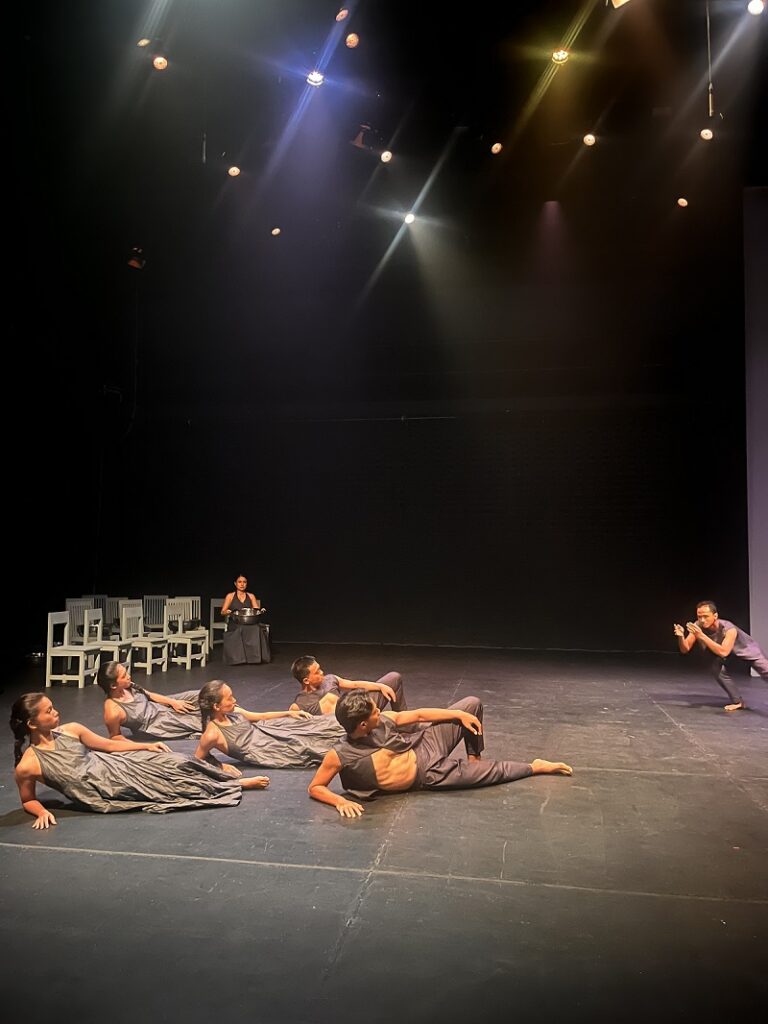
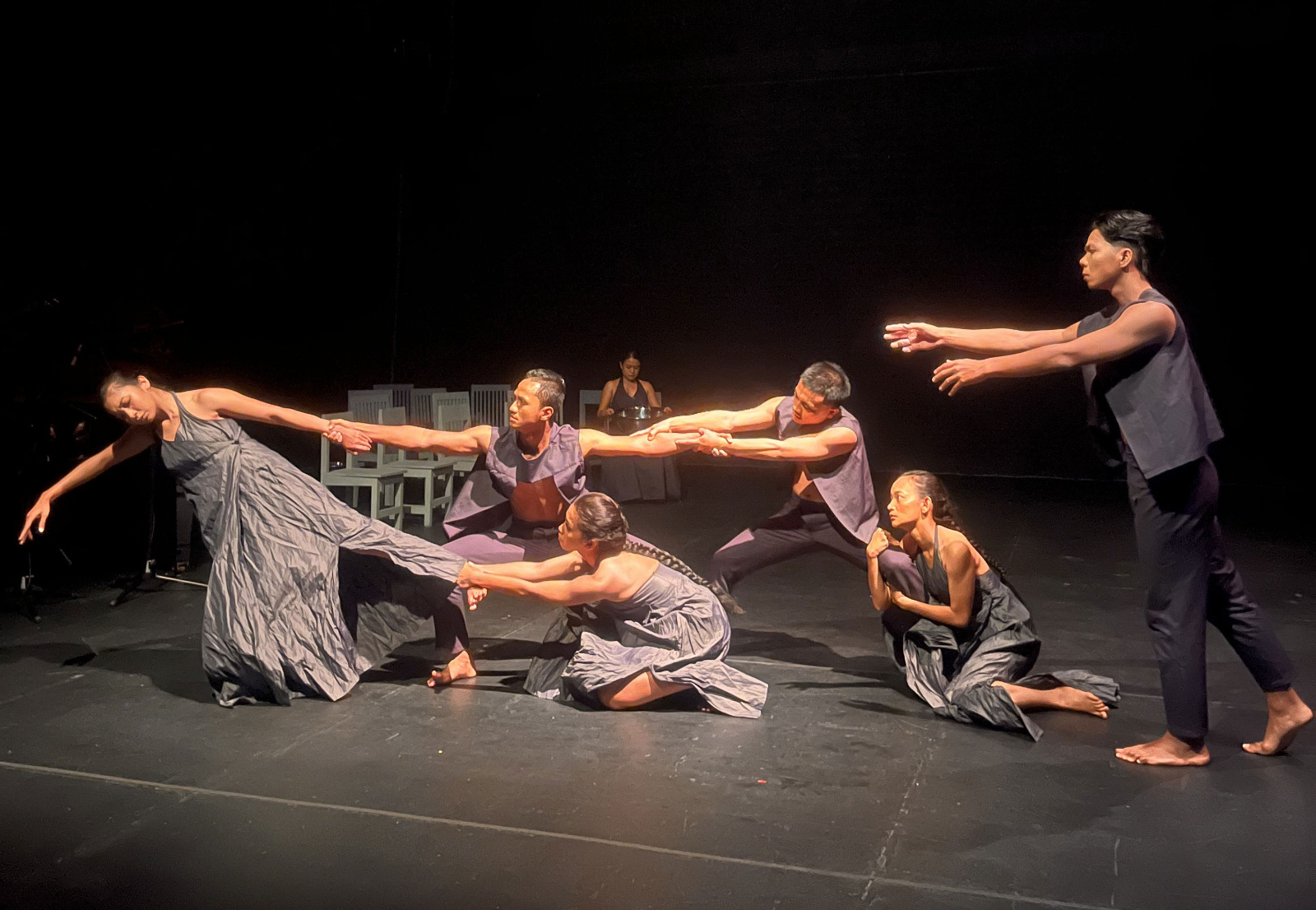
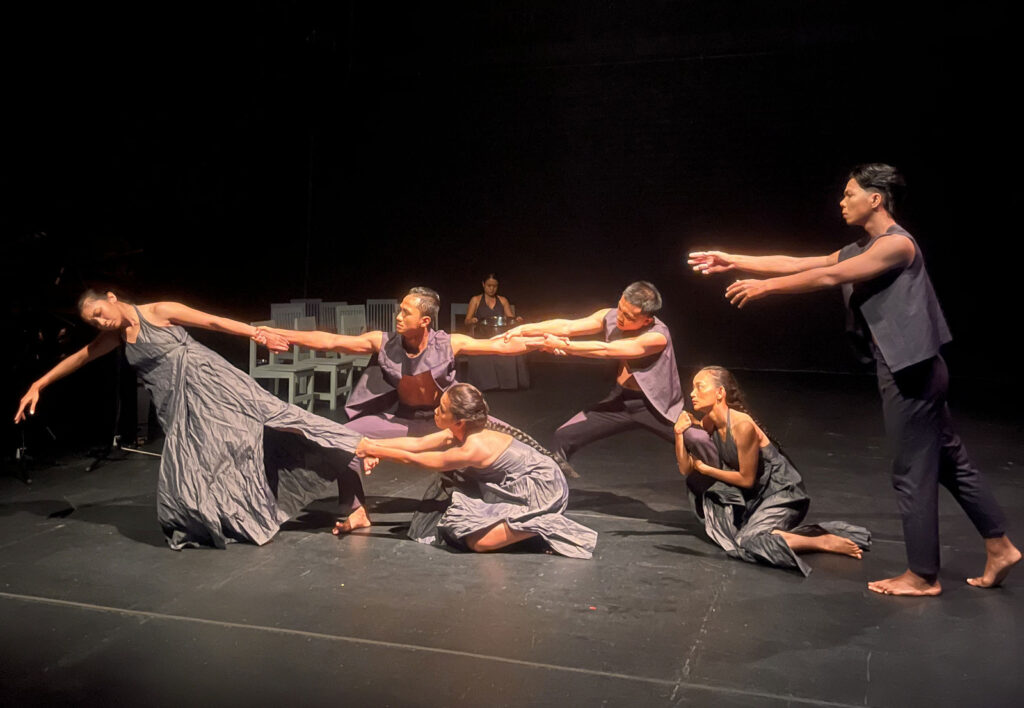
This entrapment becomes clearest when the dancers gather around a woman leaning away from them. Several hold her arm, waist, and dress while a man reaches towards her from only a short distance. The movement makes the separation feels like a body being carried away by an unseen current. Everyone appears to be resisting it, yet their effort only makes the distance more visible. No matter how closely the bodies gather, reunion remains out of reach.
The ensemble of Annastasya Verina Aryanti, Chrisnar Bagas Pamungkas, Mekratingrum Hapsari, Dani S. Budiman, Razan Wirjosandjojo and Sekar Trikusuma carry the story through their bodies and expressions. At times, Orfeus seems split between all six of them, with grief passing from one performer to another through a reach, a fall or a hand that stops just before contact.
Sri Hanuraga’s music resists turning the tragedy into something overly sentimental, even as it catches the ache of loss and yearning. Built around repetition and delay, it circles back on itself, much like the train motif in the poem. Rebecca Kezia’s reading brings Goenawan’s words into the production without turning it into an illustrated recital, the words appear like layers of memory.
Perhaps some of the show’s most underrated work comes from Tri Doso Novrianto and Surya Bantrang Jenar, responsible for the cinematography and lighting design. Novrianto’s monochrome projections keep filmed bodies, shadows and the station wall hovering behind the dancers, while Jenar’s amber, pink and violet lighting makes them appear submerged, briefly visible before fading back into darkness.
The production does occasionally remain with an image after its meaning has already landed. Some repetitions deepen the sense of obsession, while others make the rhythm feel stretched. There are brief moments when my attention loosens, only for a change in posture, sound or distance to pull it back. That feels different from boredom. The production creates its own rhythm, and part of watching it involves giving yourself over to that slower pulse.
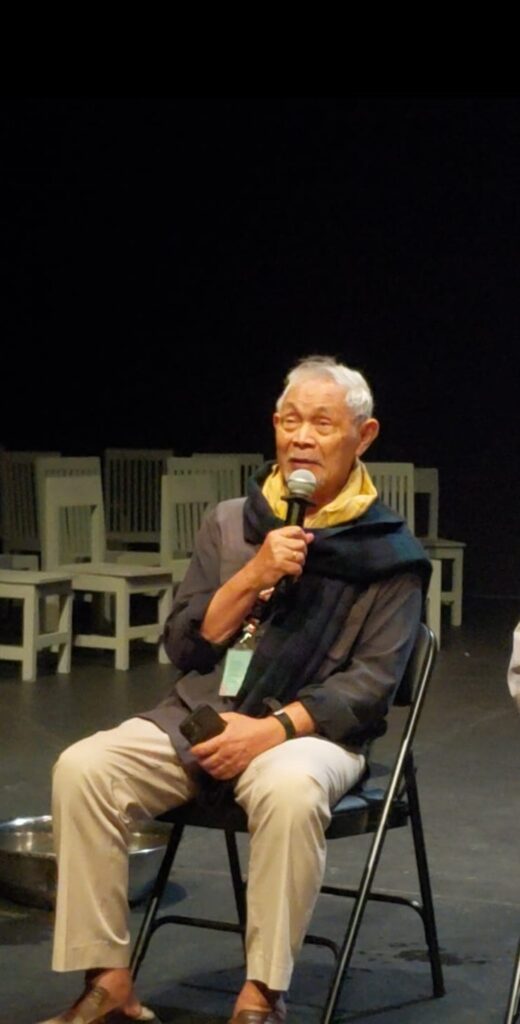
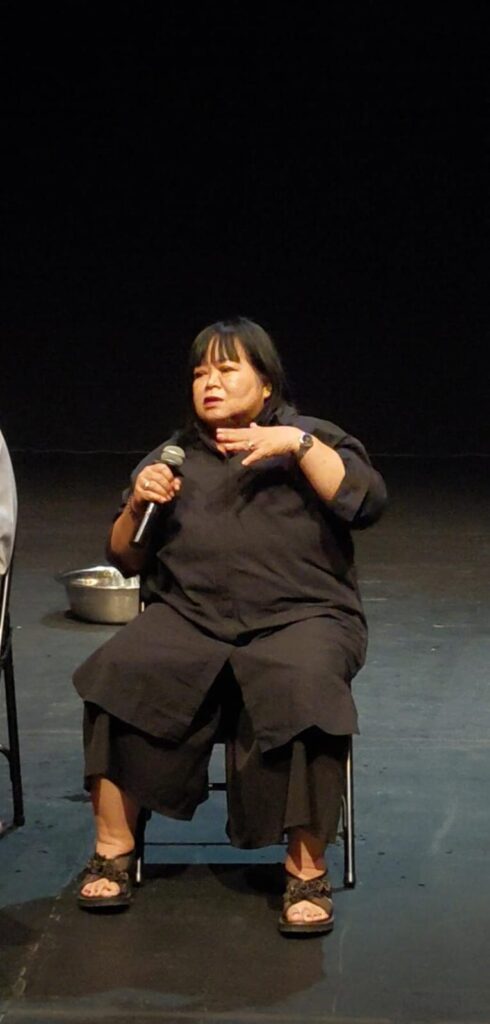 Goenawan Mohamad and Melati Suryodarmo during the Artists Talk Session
What prevents the performance from becoming a familiar tale of lost romance is Eurydice’s refusal. Her statement, “I will not return”, is firm. The tragedy comes from Orpheus’s belief that wanting something intensely may be enough to reverse reality. Melati described this as, “a human tendency to create suffering by chasing an illusion of the past. We may believe desire carries us forward,” she said. ”When it actually pulls us backward.”
Orfeus gives that idea physical form through its choreography. The backward glance is no longer one fatal turn of the head. It becomes a repeated pattern of reaching, folding, following and failing to arrive. The production leaves its dancers suspended between worlds, moving as though the past has changed the substance around them.
By the end, the question is no longer whether Orpheus will look back, but whether anyone carrying a past like his could keep moving forwards at all?
Orfeus was staged on 1–2 August 2026 at the Salihara Arts Centre as part of the opening weekend of SIPFest 2026: asiaria. Komunitas Salihara’s biennial international performing-arts festival runs until 30 August. The month-long festival brings together artists from Asia and the Asian diaspora, including Sankai Juku, Ho Rui An, Wang Chong, Monica Lim and Mindy Meng Wang, alongside Indonesian names such as Melati Suryodarmo, Rukman Rosadi, Siko Setyanto and KUNTARI. The programme spans theatre, dance, music and works still in development, with Orfeus setting the tone for the performances still to come.
View the full SIPFest 2026 programme and ticket information at sipfest.salihara.org

