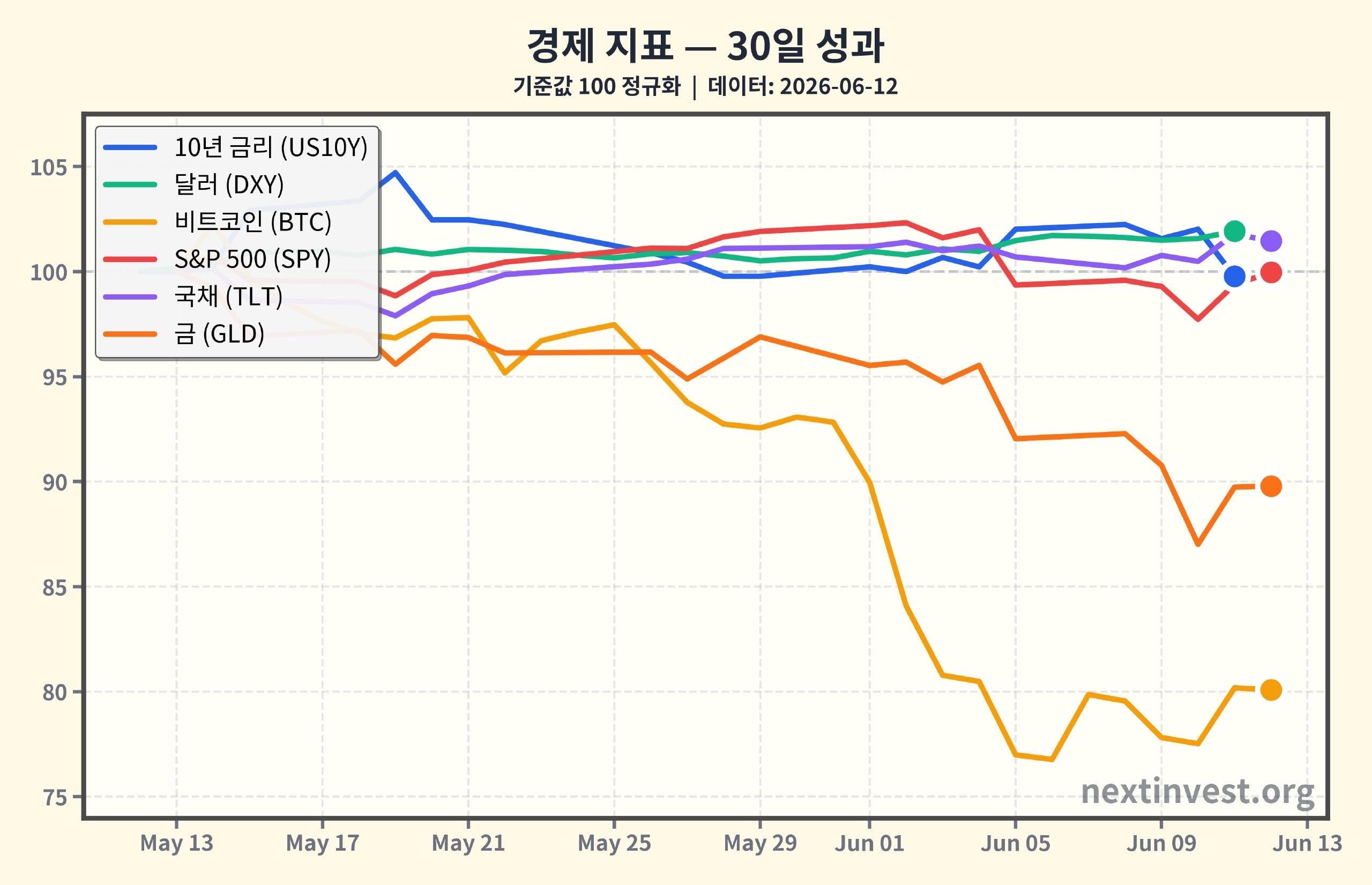
June 2nd Week Market Summary - **Energy Inflation Rekindled, Mixed Signals for Long-Term Interest Rates and Growth Stocks**
## This week's key theme: "Prices are heating up again, but the market is responding selectively"
This week's keywords for the US market were energy inflation rekindled and fading expectations of Fed rate cuts.
- May Consumer Price Index (CPI) rose 4.2% year-on-year, hitting a three-year high. It met expectations, but it clearly signaled that "prices are rising again." (bls.gov)
- A significant portion of the price surge came from soaring energy prices (especially oil), while core inflation (excluding food and energy) was relatively subdued. (ftportfolios.com)
- Nevertheless, the market interpreted it as "the Fed is less likely to cut interest rates," effectively eliminating expectations of rate cuts this year and even starting to price in the possibility of a hike. (money365.market)
Interestingly, even amidst this macro shock, stocks, bonds, the dollar, and commodities moved in different directions.
The key takeaway for investors is:
> "Prices are rising again, but the Fed won't act immediately. In the meantime, real interest rates (interest rates adjusted for inflation) will rise, creating a relative opportunity for energy and value stocks while putting pressure on growth stocks and high-valuation assets."
---
## Interest Rates and Bonds: Nominal 10-Year Yields Slightly Flat, Real Interest Rates Continue to Rise
### 1) Summary of this week's movements
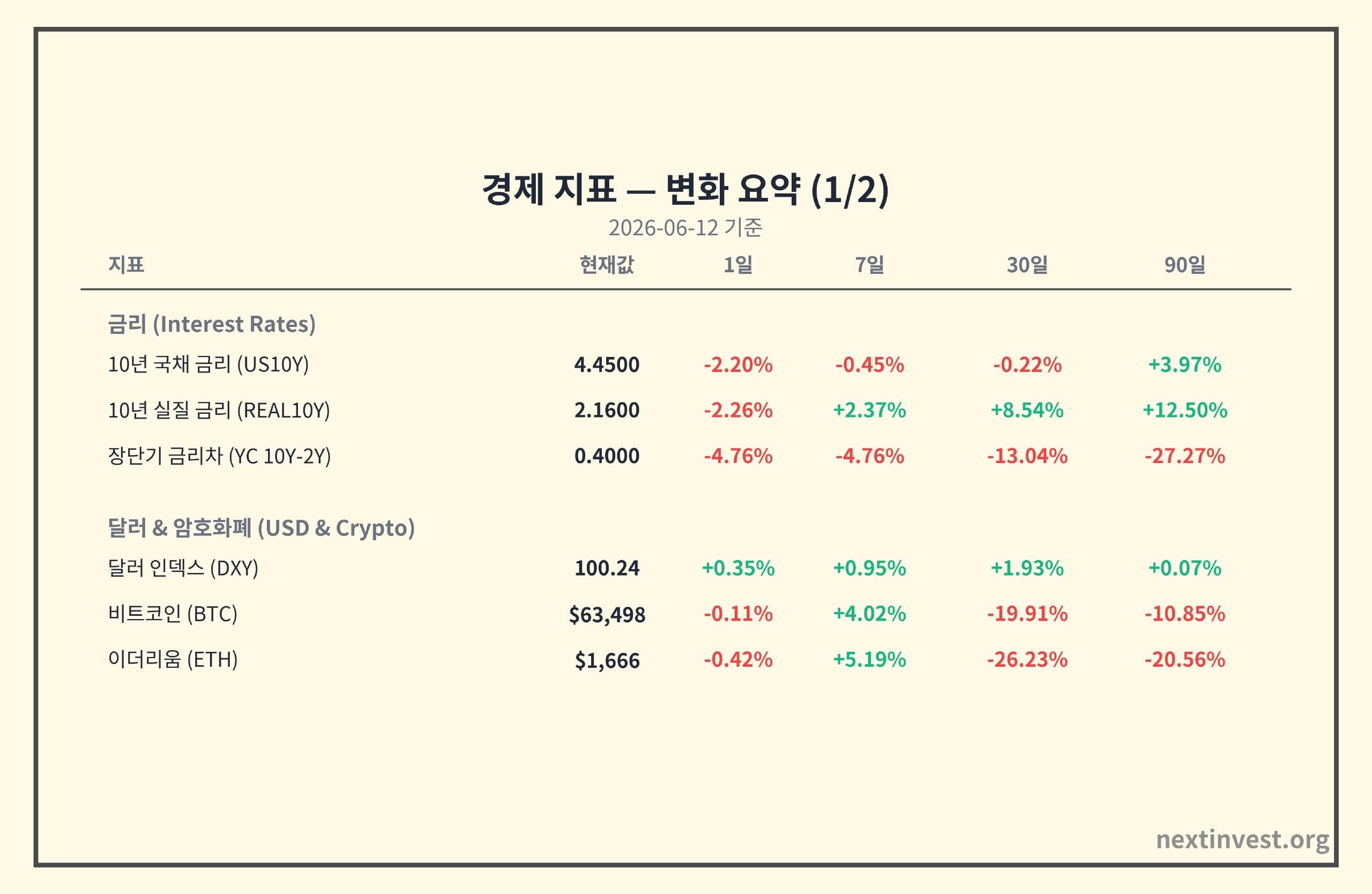
- 10-year Treasury yield: 4.45%, down -0.45% from last week (Slight decrease)
- 10-year real interest rate (TIPS): 2.16%, up +2.37% from last week (Increase)
- 10-Year – 2-Year Yield Spread (Yield Curve): 0.40%, down -4.76% from last week (Short-term interest rates relatively stronger than long-term interest rates)
Although nominal long-term interest rates fell slightly, real interest rates rose, and the short-term – long-term interest rate spread narrowed this week. This is because:
1. Price shock → Reduced expectations of Fed rate cuts → Overall interest rate levels remain high
2. Geopolitical risks (Iran war, ceasefire hopes, etc.) and economic fatigue → Upper limit on long-term interest rates (advisorperspectives.com)
3. In this process, only real interest rates rose, strengthening the "holding dollar assets means receiving relatively high interest even considering inflation."
### 2) CPI announcement and its message to the bond market
- May CPI rose +0.5% month-on-month and +4.2% year-on-year, exceeding 4%. (bls.gov)
- According to BLS details, the energy index alone rose 3.9%, explaining over 60% of the total increase. (ftportfolios.com)
- In contrast, core inflation (excluding food and energy) rose +0.2% month-on-month and +2.9% year-on-year, remaining relatively stable. (kiplinger.com)
In other words, bond investors could interpret that "while overall prices are rising due to the energy shock, it doesn't mean inflation is spreading across all sectors."
Therefore:
- Long-term Treasury yields (10-year) remained flat or slightly down week-on-week, (advisorperspectives.com)
- Instead, real interest rates (interest rates adjusted for inflation) rose more significantly.
### 3) Position of This Week Within Long-Term Trends
Looking at structural data:
- Base Rate (Fed Policy Rate): Has been in a downward trend since November 2024 (approximately -22%)
- 10-Year Nominal Rate: Gradual downward trend since October 2023 peak (-6% range)
- 10-Year Real Rate: Was in a slight reversal of decline (-7% range) since end of 2023, but has shown renewed strength with +12.5% increase over the past 90 days
This week can be understood as a period where "while the Fed has already been lowering the base rate, market rates are struggling to fall further due to energy-driven inflation" within this trend.
#### What Does It Mean for Investors?
1. Bonds
- The phase of simply expecting "rate decline → bond price increase" has largely passed.
- Rising real rates can create volatility in long-term government bonds (such as TLT), and bonds with longer duration (maturity) may see greater price fluctuations.
2. Loans and Real Estate
- The fact that the 10-year rate remains in the mid-to-late 4% range means mortgage rates are staying at elevated levels.
- Assets with high leverage (debt) such as real estate and REITs still face structural headwinds.
3. Asset Allocation
- Unlike the past when there were "few alternatives to cash and short-term bonds," dollar-denominated bonds now offer nominal yields in the 4% range and real yields in the 2% range.
- For portfolios with too high an equity allocation, this is also a timing to gradually increase bond allocation for long-term risk diversification.
---
## Dollar and Foreign Exchange: DXY Showing Slight Strength, "Appeal of Dollar Assets" Re-emphasized
- Dollar Index (DXY): 100.24, week +0.95%
- Over 90 days, it's nearly flat (+0.07%), but this week saw net inflows into the dollar thanks to inflation and Fed story.
### Why Did the Dollar Strengthen?
1. Rising Real Rates
- As we saw earlier, when interest returns relative to inflation (real rates) rise, global investors have more reasons to hold dollar-denominated assets.
2. Energy and Geopolitical Risk
- As uncertainty increases due to factors like the Iran conflict and soaring oil prices, global investors tend to move away from risk assets toward dollar and U.S. Treasury bonds, which they view as relatively safe.(kiplinger.com)
3. The Fed's Signal of "No More Easy Easing"
- The market is pricing in the possibility of a hold or even a small rate increase later in the year rather than further cuts. This is typically a factor supporting dollar strength.(money365.market)
#### What Does It Mean for Investors?
- For investors holding foreign stocks and emerging market assets (such as VWO), dollar strength can have both positive and negative impacts on returns in won terms.
- Even if returns are positive on a local currency basis, won-denominated returns can differ if dollar strength coincides with won weakness.
- Longer term, it's worth noting that if dollar strength persists too long, it could become a headwind for economic growth and asset markets outside the U.S.
---
## Stock Market: Tech and Semiconductors Re-surge, Indices Maintain Year-to-Date Strength
### 1) This Week's Performance
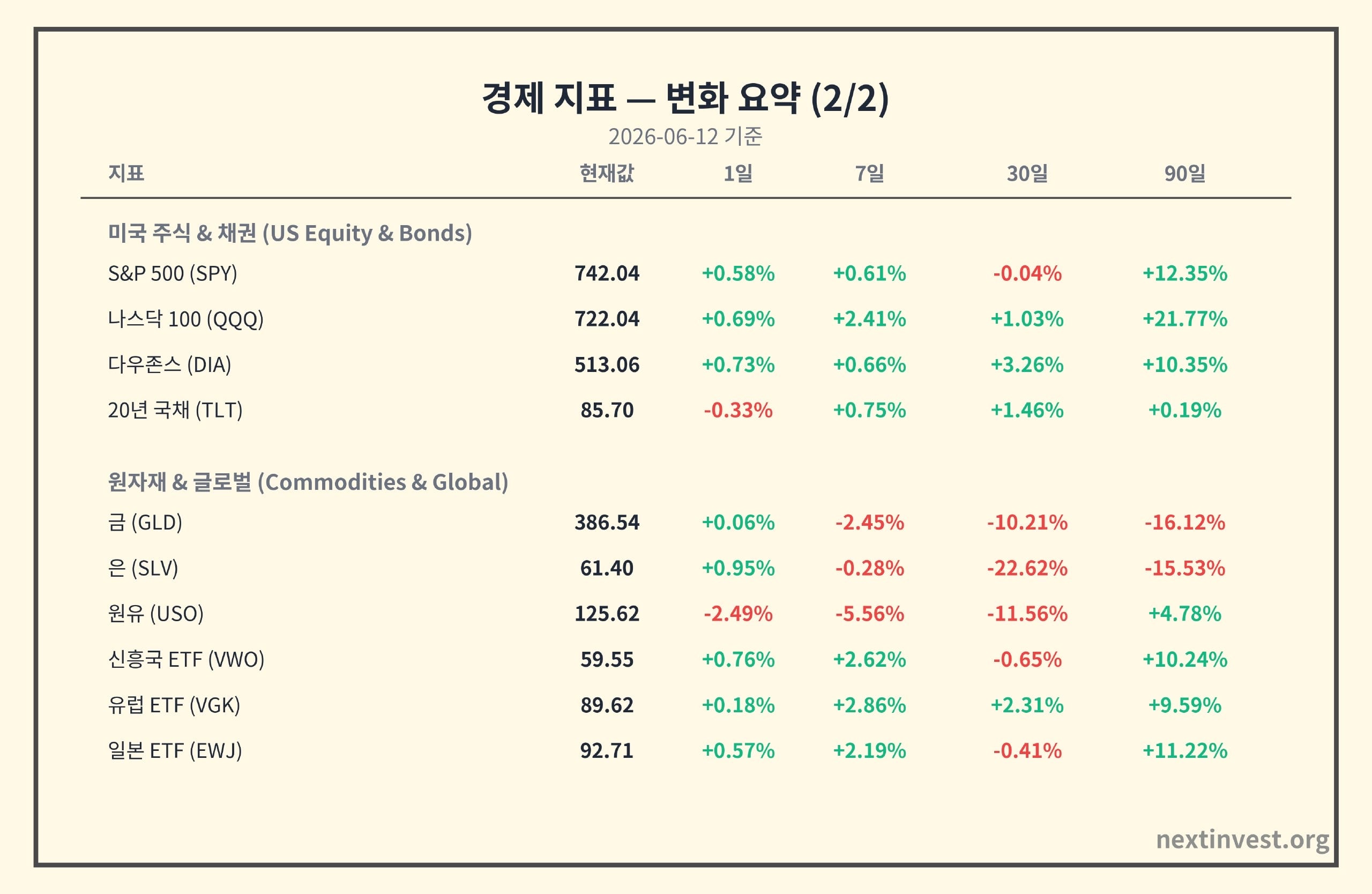
- S&P 500 ETF (SPY): week +0.61%, 90 days +12.35%
- Nasdaq 100 ETF (QQQ): week +2.41%, 90 days +21.77%
- Dow Jones ETF (DIA): week +0.66%, 90 days +10.35%
This week's characteristic is that growth and semiconductor-focused tech stocks, which faced correction last week, bounced back strongly.
- From the beginning of the week (June 8th), semiconductor stocks rebounded significantly, with the Nasdaq leading the market. In particular, news such as Nvidia's expansion of memory cooperation and Intel's large-scale AI chip production stimulated investor sentiment. (kiplinger.com)
- According to AP·Research House, after last week's adjustment, this week was seen as a "pause in the AI rally before resuming." (apnews.com)
### 2) Inflation Rise vs. Growth Stock Strength: A Paradox?
On the surface, it may seem strange that "prices are rising, so why are growth stocks, which are sensitive to interest rates, going up?"
The key is the difference between market expectations and actual data.
- The market was worried about worse (hotter) inflation, but the actual announcement was "hot, but within expectations."
- In particular, the fact that core inflation was less hot than expected gave growth stocks a sense of relief that "the worst has been avoided." (techtimes.com)
- With the addition of individual sector stories such as AI demand, corporate earnings expectations, and semiconductor investment cycles, a growth narrative was formed that could offset interest rate burdens.
#### What does this mean for investors?
1. Investors with a high proportion of growth stocks
- While a rebound may follow the adjustment in the short term, it is important to consider the possibility of increased volatility given the rise in real interest rates and the hawkish stance of the Fed.
- Remember that ETFs like QQQ, which have a high weighting in technology and semiconductors, react significantly to interest rate and inflation news.
2. Value stock and dividend stock investors
- Indices such as DIA (Dow Jones Industrial Average) that are centered on cyclical and value stocks also saw gains this week, but not to the same extent as tech stocks.
- In a period of high interest rates and rekindled inflation, interest in dividend stocks with stable cash flow may increase again.
---
## Commodities and Cryptocurrencies: Gold and Silver Continue to Decline, Oil Prices Fall, Bitcoin and Ethereum See a Weak Rebound
### 1) Gold and Silver, "Inflation Hedge" Title Shaken
- Gold ETF (GLD): 1 week -2.45%, 30 days -10.21%, 90 days -16.12%
- Silver ETF (SLV): 1 week -0.28%, 30 days -22.62%, 90 days -15.53%
Despite rising prices, gold and silver, traditionally considered inflation hedges, have seen significant declines.
Reasons:
- Rising real interest rates → Increased opportunity cost for gold and silver, which do not pay interest
- Dollar strength → Downward pressure on the prices of gold and silver, which are traded in dollars
In other words, the market is currently looking for "inflation protection" not in gold and silver, but in dollar bonds, energy, and real assets.
### 2) Oil and Energy
- Oil ETF (USO): 1 week -5.56%, 30 days -11.56%, 90 days +4.78%
Oil prices have surged in recent months, driven by the war in Iran and supply concerns, contributing to CPI inflation. However, this week saw a correction due to expectations of a ceasefire and slowing demand. (reddit.com)
- However, with a 90-day gain of +4.78%, energy inflation pressure has not completely disappeared.
### 3) Cryptocurrencies: Reinforcing the Role of "Digital Risk Assets" in Inflation
- Bitcoin (BTC): 1 week +4.02%, 30 days -19.91%, 90 days -10.85%
- Ethereum (ETH): 1 week +5.19%, 30 days -26.23%, 90 days -20.56%
After the CPI announcement, the coin market briefly shook as "the Fed's maintenance of high interest rates" was reconfirmed, but Bitcoin rebounded slightly while holding above $60,000. (coindesk.com)
From an investor's perspective:
- Bitcoin and Ethereum are moving closer to high-risk growth stocks rather than "digital gold."
- As inflation rises, the period from the 30th shows that coins often weaken when real interest rates rise and the dollar strengthens.
---
## Next Week's Focus Points: "What story will the market choose before the Fed meeting?"
Next week (before and after the Fed meeting), it is highly likely that the three stories formed this week will continue to shake the market.
1. Energy Inflation vs. Core Price Stability
- Investors will try to interpret whether "this price increase is a temporary energy shock or a harbinger of continued service price increases."
2. The Fed's Tone (Statement)
- Even if interest rates are not changed immediately, the direction of real interest rates,
- growth stocks,
- high-valued assets,
- and gold
could change significantly depending on how hawkish the dot plot and chair's remarks are.
3. Economic Strength: Employment and Demand Indicators
- Recent employment has been stronger than expected (172,000 non-farm jobs in May vs. 85,000 expected), which led to the interpretation that the economy is still holding up → the Fed will not ease easily. (alphabriefing.com)
- At the same time, real wages are declining, creating a situation where perceived economic conditions and statistical economic conditions diverge. (ftportfolios.com)
---
## Conclusion: A Realistic Checklist for Investors Now
Finally, here are some questions for individual investors to check based on this week's data.
1. Is the interest rate and inflation sensitivity of my portfolio too high?
- Check if the proportion of growth stocks, long-term bonds, and coins is excessively high.
2. Is the proportion of "assets that do not pay interest" appropriate in an environment where real interest rates are rising?
- Check if your logic for holding gold, silver, and coins is still valid.
3. How will I manage exchange rate risk when the dollar strengthens?
- Develop a habit of looking at overseas ETFs and stocks in both Korean won and US dollar terms.
4. What will happen to my portfolio if energy prices surge again?
- If there is no exposure to energy or commodities at all, consider adding a small hedging position.
This week's market sent mixed messages depending on the asset class, with "reheating inflation" as bad news and reassurance that it was "within expectations."
There are no right answers in investing,
> but the habit of understanding "why prices are rising or falling" with data and stories will be your biggest defense in times of future volatility.
This content is for informational purposes only and does not constitute investment advice on any specific security or asset.
Source: https://nextinvest.org/ko
Free to redistribute ^^