6/8 US Stock Market - Tech Stocks Surge on AI Rebound, Utilities and Real Estate Decline
June 08, 2026 Market Analysis
## 1. What Happened Today?
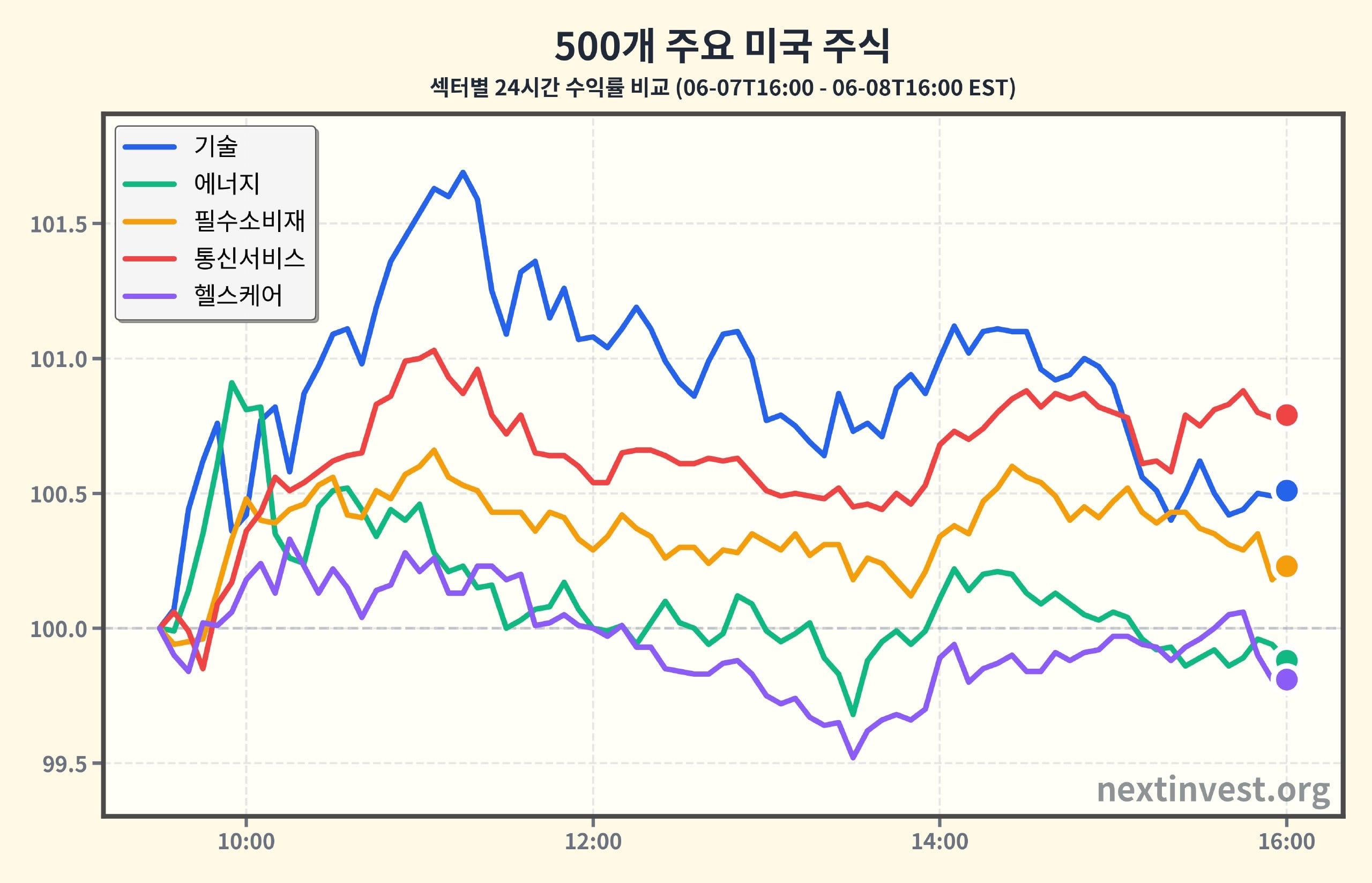
On Monday (June 8th), the US stock market saw a "tech stock rebound" as some of the losses from last Friday's large tech stock sell-off were recovered.
- Overall Sentiment: Generally bearish (negative) atmosphere
- Sector Performance: Only 2 out of 11 sectors showed gains (technology and energy), while the rest declined
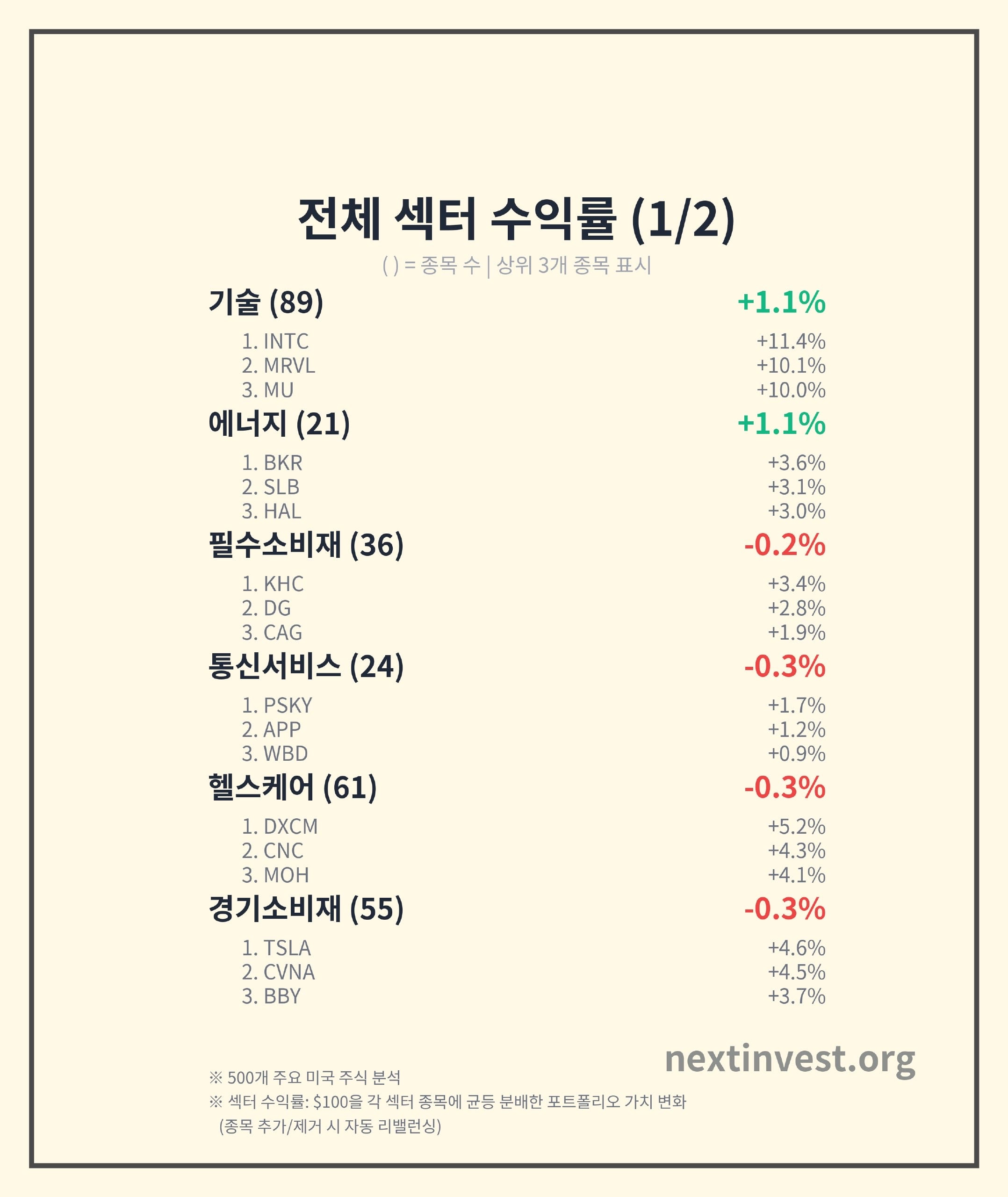
- Leading Sector: Technology (+1.12%)
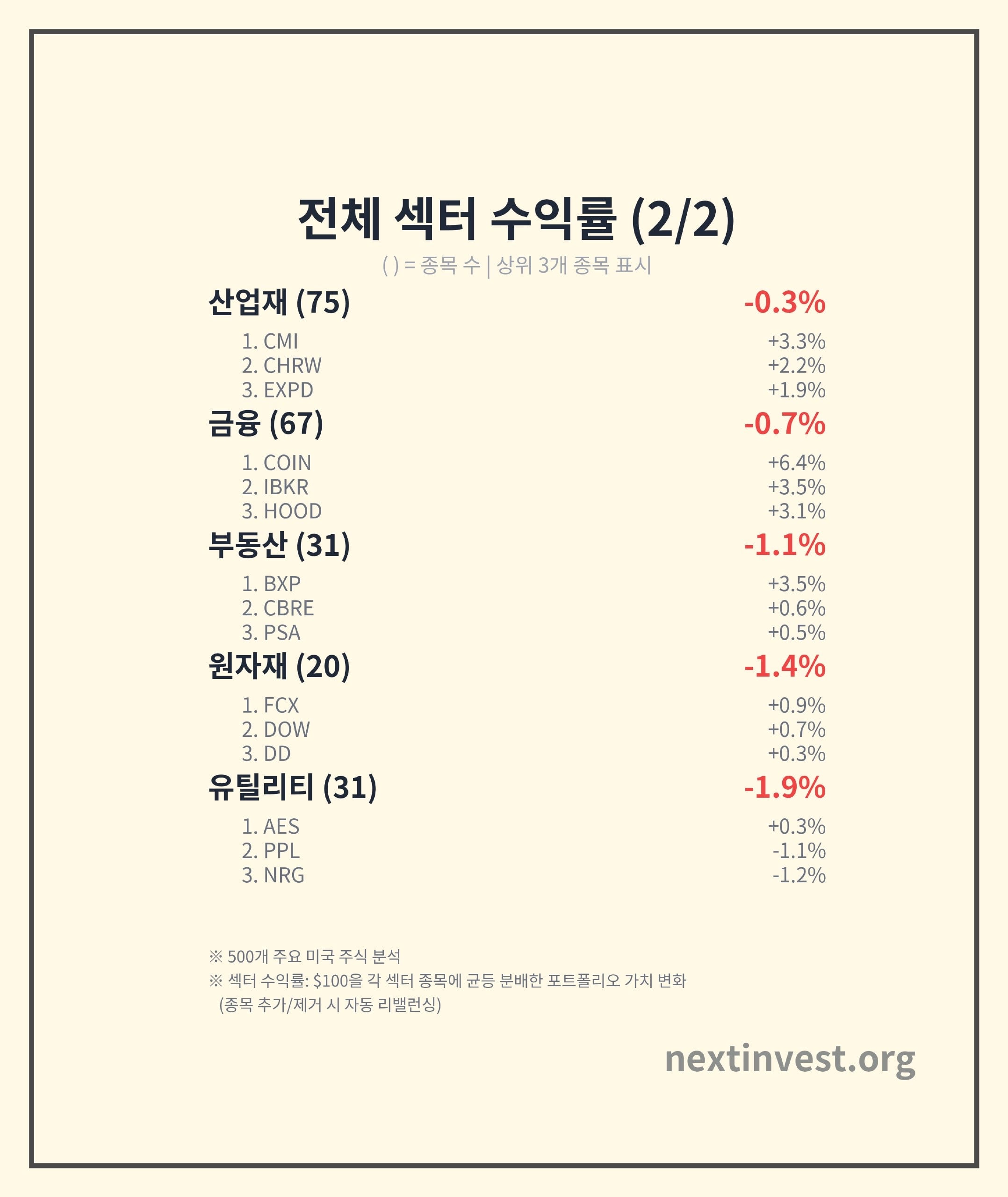
- Lagging Sectors: Utilities (-1.86%), Basic Materials (-1.44%), REITs/Real Estate (-1.15%)
The key takeaway is that AI-related semiconductor stocks lifted the market again, but interest rate and economic sensitive sectors continued to face pressure. Last week's tech stock sell-off hasn't completely subsided, and it can be summarized as "the AI growth story remains valid, but valuation concerns are growing." (apnews.com)
---
## 2. Technology Stocks: AI Semiconductor Rebound Led by Intel, Marvell, and Micron
### 2-1. Starting with Today's Numbers
- Sector Return (24H): +1.12% (1st out of 11)
- 7-Day Trend:
- 6/2: +0.39%
- 6/3: -1.34%
- 6/4: -0.48%
- 6/5: -5.43%
- 6/8: +1.12%
→ Tech stocks rebounded partially today after a -5% drop last Friday. The losses haven't been fully recovered yet.
- Representative Stock Performance:
- Intel (INTC) +11.42%
- Marvell Technology (MRVL) +10.07%
- Micron (MU) +9.97%
- Other semiconductor equipment stocks like KLA and Applied Materials also performed well
### 2-2. News Behind Today's Tech Stock Rally
1. AI Semiconductor Stocks Rebound After Friday's Sell-Off
- Listed companies, particularly those related to AI semiconductors, experienced a significant decline last Friday due to concerns that they had risen "too much, too quickly" and the impact of strong employment data. (apnews.com)
- Today's rebound is attributed to a renewed belief that "the AI cycle hasn't ended, it's just taking a breather." (fool.com)
2. Intel: Emerging as a Key Partner for Large Customers' AI Chip Manufacturing
- Intel's stock price surged after reports that Alphabet, Nvidia, and Tesla are considering having Intel Foundry manufacture their next-generation AI accelerator chips. (fool.com)
- Aligned with the government's strategic industry development policy, Intel is being reevaluated as a "core pillar of US AI manufacturing infrastructure." Some reports suggest that the government may increase its stake in key AI companies, including Intel, further fueling expectations for political and policy support for the AI industry. (tipranks.com)
3. Marvell and Micron: "Essential Component Stocks" for AI Data Centers
- Marvell benefited from anticipation of its inclusion in the S&P 500 and strong buying interest driven by demand for AI networking/accelerator chips. (livemint.com)
- Micron is nearing a 'sold out' situation for HBM (High Bandwidth Memory) used in AI data centers, and anticipation ahead of the earnings announcement scheduled for June 24th pushed up the stock price. (fool.com)
### 2-3. Mid-Term Trends and Today's Significance
- Sector Long-Term Performance:
- 100 on March 13th → Currently 133.40 (approximately +33%)
- Steep rise from late March until mid-May, followed by adjustments since early June
- Current Phase: Down 5.52% since June 3rd, with a rebound today.
In essence, we are still within the 'AI-driven bull market,' but volatility has increased significantly since June, leading to an adjustment phase.
> What it means to me:
> If you have already invested in AI/semiconductor ETFs or individual stocks, the question is not "Is this the beginning or the end?" but rather "How much volatility can we expect?".
>
> - Short-term (a few weeks) adjustments of -5 to -10% could occur at any time,
> - Long-term (several years), the narrative of AI data center investment expansion leading to profit growth remains intact.
> For long-term investors, 'tolerance for volatility' is a key risk management point.
---
## 3. Energy: Modest Rebound Amid Oil Prices and Geopolitical Risks
- Sector Return (24H): +1.06% (one of two rising sectors)
- Representative Stocks: Baker Hughes (BKR) +3.59%, SLB +3.06%, Halliburton (HAL) +3.04%
- 7-Day Trend: Slight rise from June 2nd to June 4th, followed by a -2.39% plunge on June 5th → Rebound of +1.06% on June 8th
- 60-Day Trend: A surge of over 10% in mid-March, followed by rollercoaster-like fluctuations. Down -3.34% since May 5th.
Recent geopolitical risks in the Middle East and concerns about economic slowdown have led to significant volatility in oil prices. Today's energy stocks appear to be driven by bargain hunting following last week's decline and a technical rebound due to some oil price recovery. (apnews.com)
> What it means to me:
> Energy is a "sector that moves significantly with news headlines." For individual investors, rather than a short-term trading perspective, diversifying investments in crude oil/energy ETFs as part of the overall portfolio (e.g., 5-10%) may be a more realistic strategy.
---
## 4. Real Estate & Utilities: Weakness in Interest Rate-Sensitive Sectors
### 4-1. Today's Numbers
- Real Estate: -1.15%
- Utilities: -1.86% (lowest among 11 sectors)
Representative REITs (such as BXP) attempted a slight rebound, but the overall sector trend remains downward. (business-standard.com)
### 4-2. Why So Weak?
1. "High interest rates don't automatically make defensive stocks safe"
- REITs and utilities are often called 'bond substitutes' due to their dividend yields.
- However, with treasury bond yields and corporate loan interest rates remaining high, investors see "less reason to take on the risk of REITs/utilities."
2. Limited Growth Expectations
- Unlike AI and semiconductors, which have a "story" of significant growth potential over the next few years,
- These sectors tend to be sold off first when the market enters an adjustment phase.
### 4-3. Mid-Term Trends
- Real Estate: Up over 7% since mid-March, but recently reversed after a rebound. A modest rise of +1.63% followed the June 3rd rebound before today's significant reversal.
- Utilities: Down 5.63% overall since March. A -3.38% decline has continued since May 22.
> What this means to me:
> - If you hold REITs/Utilities for stable cash flow and dividends, you need to focus more on dividend coverage and financial health than short-term price fluctuations.
> - Until interest rate cuts are seriously discussed, it may be more comfortable to keep expectations for price momentum low.
---
## 5. Financial and Consumer Sectors: Quiet Adjustments Next to the 'AI Feast'
### 5-1. Financial Services: -0.70%
- Key stocks:
- Brokerage and trading stocks like Coinbase (COIN) +6.40%, Interactive Brokers (IBKR) +3.50%, Robinhood (HOOD) +3.12% are performing well
- Nevertheless, the entire sector closed down -0.70%.
This can be understood as "trading is active, but traditional finance such as banking and insurance are being pressured by interest rates, loan loss costs, and regulatory risks."
Looking at the 60-day trend, Finance showed steady gains until April, followed by a correction in early May, and since May 11 has been in a gentle uptrend of approximately +1.29%. Today's decline can be interpreted as a one-day adjustment within this gentle upward trend.
### 5-2. Consumer Sector: Both Defensive and Cyclical Slightly Down
- Consumer Defensive: -0.23%
- Consumer Cyclical: -0.29%
- Key stocks:
- Defensive consumption: Some stocks like Kraft Heinz (KHC) +3.41%, Dollar General (DG) +2.81% are strong
- Cyclical consumption: High-volatility individual stocks like Tesla (TSLA) +4.58%, Carvana (CVNA) +4.50% are strong
The sector index itself is down, but it's a 'selective market' with some notable rising stocks mixed in.
That is, rather than "just buying all consumer stocks," it's a phase where performance differences are large depending on individual companies' earnings and momentum.
> What this means to me:
> Consumer and financial sectors may be more advantageous to invest in by picking a few business models you understand rather than buying the entire sector with a single index ETF.
> Especially for highly volatile stocks like Tesla and Carvana, even if you believe in the long-term story, position sizing and risk management are essential.
---
## 6. Combining 7-Day and 60-Day Flows: "The AI Rally Continues, But Volatility Has Increased"
### 6-1. 7-Day (Short-Term) Perspective
- Economic and growth-sensitive sectors such as technology, finance, and energy have seen repeated sharp rallies and sharp declines in recent days.
- Defensive consumer staples and utilities are oscillating between positive and negative with no clear direction.
That is, rather than any one sector rising consistently, it's a market where leaders keep changing - AI one day, energy the next day, then defensive stocks.
### 6-2. 60-Day (Medium-Term) Perspective
- Technology: Still has an overwhelming return of +33%, but entered a correction phase in June.
- Energy, industrials, and healthcare: Gentle gains in the 3-7% range. Balanced growth sectors not concentrated on any particular theme.
- Communication, consumer, and utilities: In the 0% or negative return range, classified as relatively disfavored sectors in the market.
> To summarize:
> - Looking at returns over the past 2-3 months, the "growth stock rally centered on AI/semiconductors" is still the core.
> - However, since June, the warning that "even good stories can be shaken anytime if the valuation is too high" is manifesting in actual prices.
---
## 7. Today's Summary for Individual Investors
1. AI and Semiconductors:
- Today's strong rebound is an event that temporarily calmed fears that the AI cycle has ended.
- However, considering the corrections that have continued since early June, it's a high-risk period that could see daily swings of -5 to 10% in the future.
2. Defensive Stocks & Dividend Stocks:
- Utilities, REITs are showing the typical high-interest rate environment pattern of "dividends are good, but prices are volatile."
- If you've invested in this sector, it's important to check dividend stability and debt structure before price.
3. Sector Diversification:
- Days like today, where only technology rises and the rest mostly fall, may repeat.
- If you're overly concentrated in one sector (especially AI/semiconductors), you're more susceptible to volatility.
- Diversifying with sector ETFs like 'technology + energy + healthcare + defensive stocks' can mitigate the impact of individual theme adjustments.
4. Time Frame Check:
- Today's news and movements are both an opportunity and a risk for short-term traders,
- For long-term investors, it's more like a litmus test to check if "you can withstand this volatility."
---
## 8. Conclusion: Today's Market in One Sentence
> "AI semiconductors reignited the fire, but other sectors remain cautious under the shadow of interest rates and valuations."
The AI story is likely to remain at the center of the market for several years to come. However, today's market clearly shows that a good story ≠ always a good buying time.
When planning your investments, it's crucial to consider not only "what to buy" but also "when, how much to buy, and how long to hold."
This content is for informational purposes only and does not constitute investment advice for any specific security or asset.
https://nextinvest.org/ko
Feel free to share ^^