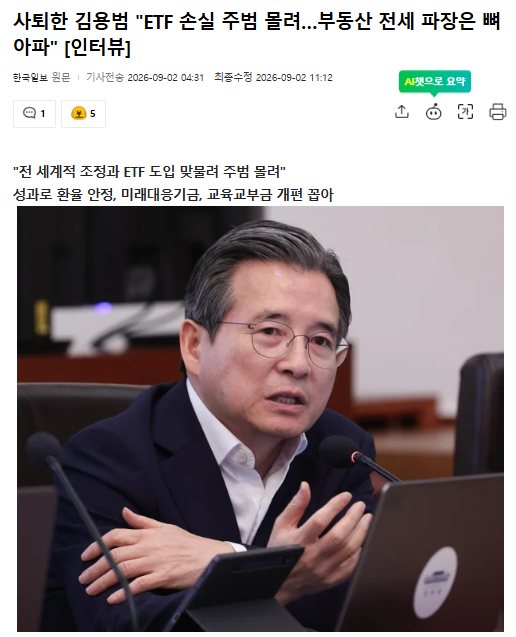
Kim Yong-beom, the presidential policy director who stepped down from his position after 15 months, spoke on September 1st about the single-asset leveraged exchange-traded fund (ETF) introduction and responsibility for real estate policies that had been the reason for opposition parties' calls for his resignation.
"Blamed as the main culprit as global adjustment timing coincided with leveraged ETF introduction"
In a phone interview with Hankook Ilbo on that day, Director Kim emphasized the context that when the leveraged ETF was introduced in late May, the won-dollar exchange rate exceeded 1,500 won and soared to a record high, making currency defense urgent. He explained the circumstances, saying, "In the meeting at the time, we discussed the question of why our country particularly invests heavily in U.S. Nasdaq. As we talked about product differences between Korean and U.S. stock markets, that kind of idea came up."
Regarding the fact that the KOSPI, which had once risen to 9,000 points, subsequently plummeted and losses for leveraged ETF investors increased, he lamented, "As the timing of a global adjustment coincided with the timing of ETF introduction, I was blamed as the main culprit that magnified losses."
However, Director Kim added, "Didn't the government not encourage citizens to subscribe to leveraged ETFs at that time?" and "There is also a quite significant portion where people who invested aggressively at that time incurred losses."
"Real estate demand was about to explode amid record-breaking prosperity"
Director Kim also addressed the real estate policy controversy, which is cited as a major cause of the president's declining approval rating. He explained, "During the Yoon Suk-yeol administration, retail sales were negative throughout the term, but our administration jumped into resuscitation through supplementary budgeting, and with the ensuing semiconductor boom, the strength of real estate demand became incomparably record-breaking strong." He added, "Supply cannot be suddenly increased, so how could we prevent demand from exploding?" This means that demand suppression measures had to be implemented given the considerable concern that if left alone, liquidity in the market would cause housing prices to skyrocket.
However, regarding last year's October 15 real estate measure that expanded regulated areas to all of Seoul and 12 areas in Gyeonggi Province, Director Kim said, "I painfully acknowledge the impact on the jeonse market due to the suddenly increased demand for actual residence caused by stricter regulations." Regarding the Democratic Party's opposition to the government's original tax law amendment bill, including strengthened taxation for non-resident single-home owners, he said, "Of course there are such parts," but evaluated, "I believe the remaining 95-98% was done according to the government's original plan." He expressed a wish that measures to block "loophole" business succession deductions and other measures included in the tax law amendment bill would also be evaluated fairly.
Cites achievements as won-dollar exchange rate stability, future response fund, and education subsidy reform
He cited achievements including △stabilization of the won-dollar exchange rate, △establishment of a 162 trillion won future response fund included in next year's budget, and △education subsidy reform. Regarding the establishment of the future response fund, he said, "We created a framework to strategically invest by field such as youth and future, regions, and education, which will be evaluated repeatedly in the future."
====================================
"Didn't the government not encourage citizens to subscribe to leveraged ETFs at that time?" lol this is ridiculous
Personally
First, if you think it's unfair that leveraged ETF is being blamed as the main culprit, you can reveal the actual culprit.
You're criticized for real estate because what have you been doing for over a year without building houses?
▶ Original source: https://news.nate.com/view/20260902n01361?mid=n0202

